


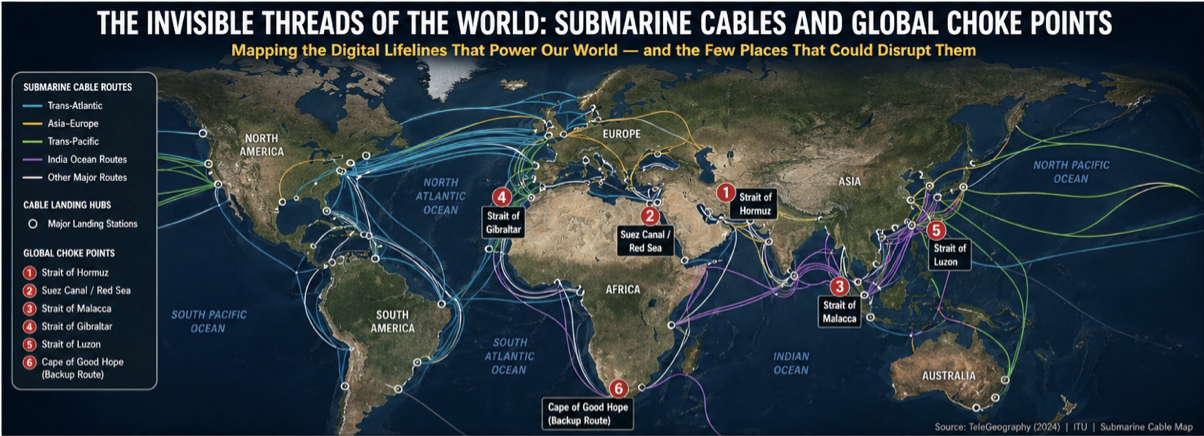

THE MYTH OF A SINGLE POINT OF FAILUR
PREAMBLE: THE ARTICLE THAT SET THE NARRATIVE IN MOTION
This analysis originates from a widely circulated report titled:
“IRAN WARNS STRAIT OF HORMUZ CABLES ARE VULNERABLE, RAISING RISK TO GLOBAL INTERNET AND DIGITAL INFRASTRUCTURE”
(Israel Realtime, April 28, 2026)
The article frames the Strait of Hormuz as a potential digital chokepoint whose submarine cable infrastructure could, under conflict conditions, threaten global Internet stability. It references multiple fiber-optic systems crossing the region and highlights risks stemming from geopolitical tension, naval activity, and historical cable faults.
While many of its factual elements—such as the existence of submarine cables in the Gulf region, the reliance of global communications on fiber, and the frequency of accidental cable damage—are broadly correct, the interpretation of systemic risk extends significantly beyond what current network architecture and traffic distribution actually support.
This essay is a technical deconstruction of that narrative, and a re-centering of the discussion on how global Internet infrastructure actually behaves under stress.
THE INTERNET IS NOT A SINGLE SYSTEM — IT IS AN EMERGENT NETWORK OF NETWORKS
The global Internet backbone is not a monolithic structure. It is a layered system composed of:
•more than 500 active submarine cable systems
•hundreds of geographically distributed landing stations
•autonomous routing protocols (primarily BGP)
•overlapping intercontinental transit corridors
This architecture is explicitly designed around one assumption: failure is normal.
When a segment fails, traffic is not interrupted. It is rerouted dynamically across alternative paths, often within seconds. The system does not require stability in any single node or corridor to remain operational.
This distinction is fundamental and often omitted in public discourse.
HORMUZ IN CONTEXT: A REGIONAL CORRIDOR, NOT A GLOBAL HUB
The Strait of Hormuz is strategically important in maritime and energy geopolitics, but its role in Internet infrastructure is often overstated.
Yes, multiple submarine cable systems traverse or approach the Gulf region, linking:
•South Asia
•the Gulf states
•onward routes toward Europe via the Middle East
However, structurally:
•Hormuz is not a global aggregation point
•it is not a mandatory transit corridor for intercontinental Internet traffic
•it is one of several regional routing segments embedded in a much larger mesh
Global connectivity between Asia, Europe, and the Americas does not depend on any single maritime corridor.
MISREADING SCALE: THE “99% OF TRAFFIC” ARGUMENT
A commonly cited figure states that approximately 99% of international Internet traffic travels via submarine cables. This is correct at a macro level, but frequently misinterpreted.
What this statistic does not imply is:
•concentration into a few chokepoints
•dependency on specific regional corridors
•systemic fragility tied to individual geographic locations
Instead, it reflects a physical reality:
submarine fiber is the dominant medium for intercontinental data transmission, distributed across hundreds of independent systems.
The key variable is not medium dependency, but route diversity.
WHAT ACTUALLY HAPPENS WHEN CABLES ARE DAMAGED
To evaluate systemic risk, one must move from narrative framing to operational behavior.
Scenario A — single cable failure
•no global disruption
•automatic rerouting
•negligible end-user impact
Scenario B — multiple simultaneous failures in one region
•increased latency between Asia and Europe
•congestion on alternative routes (Red Sea, Indian Ocean, Africa detours)
•temporary degradation of cloud and financial services in affected zones
Scenario C — severe clustered disruption
•measurable reduction in available bandwidth for specific corridors
•regional service degradation
•increased operational costs for traffic routing
At no point does this produce global Internet shutdown. The system absorbs loss through redistribution, not collapse.
THE REAL VULNERABILITY: CONCENTRATION, NOT FRAGILITY
The critical structural issue is not systemic weakness, but spatial concentration:
•certain maritime corridors carry disproportionate traffic density
•landing stations cluster in politically stable coastal zones
•regional hubs aggregate large volumes of intercontinental traffic
This produces chokepoints in the sense of capacity pressure, not existential dependency.
A chokepoint is therefore not a “switch of the Internet,” but a zone where inefficiency and latency can spike under stress conditions.
WHY CABLE FAILURES ARE COMMON — AND WHY THAT MATTERS LESS THAN IT SOUNDS
Submarine cable faults occur frequently, with global estimates often cited in the range of:
•150–200 incidents per year
However:
•most are localized
•most are accidental (anchors, fishing activity, seismic events)
•and most are resolved without systemic disruption
Critically, the global network is engineered under the assumption that such failures are routine.
Failure is not an exception condition. It is an operational baseline.
GEOPOLITICS VS SYSTEM ENGINEERING
Geopolitical narratives tend to translate distributed infrastructure into centralized risk objects:
•“digital chokepoint”
•“global vulnerability node”
•“strategic Internet switch”
Engineering reality does not support this mapping.
The Internet does not behave as a centralized machine. It behaves as a distributed adaptive system, where:
•redundancy is structural
•rerouting is automatic
•degradation replaces collapse
The difference is not semantic—it is architectural.
CONCLUSION: RESILIENCE IS NOT THE ABSENCE OF FAILURE, BUT THE ABSORPTION OF IT
The central misunderstanding in narratives like the one originating from the referenced article is not the identification of risk, but the interpretation of its scale.
Yes:
- submarine cables are critical
- Hormuz is strategically sensitive
- regional disruption is possible
No:
•the Internet is not dependent on a single corridor
•global connectivity does not hinge on Hormuz
•localized failure does not translate into systemic collapse
The global Internet is not fragile because it is vulnerable.
It is resilient because it is designed under the assumption that it will be disrupted—and will continue to function regardless.
FINAL CONSIDERATION: INFRASTRUCTURE, SIGNALING, AND THE LIMITS OF STRATEGIC INTERPRETATION
A final consideration concerns not the physical vulnerability of submarine cable infrastructure, but the broader strategic context in which such vulnerabilities are increasingly discussed.
In contemporary geopolitical environments, critical infrastructure—particularly undersea fiber-optic networks—has become part of a wider domain of strategic communication. References to “digital chokepoints” or systemic vulnerability often function not only as technical assessments, but also as elements of signaling between regional and global actors operating under conditions of heightened tension.
From this perspective, statements highlighting risks to submarine cables in the Strait of Hormuz may be read as part of an evolving pattern in which infrastructure is integrated into deterrence narratives. These narratives do not necessarily imply operational intent to disrupt systems, but rather reflect the growing interdependence between physical connectivity, economic stability, and geopolitical leverage.
However, the analytical value of such interpretations depends on maintaining clear boundaries between observable infrastructure realities and inferred strategic objectives. While it is evident that maritime corridors such as the Gulf region occupy a sensitive position within global data flows, attributing specific political outcomes or coordinated strategic aims to such warnings exceeds what available evidence can support.
More broadly, the increasing entanglement of digital infrastructure and geopolitical discourse underscores a structural feature of the current international system: critical networks are no longer neutral backdrops to state competition, but components within it. This does not, however, imply that they function as singular points of systemic control or vulnerability.
Accordingly, the most defensible conclusion is a restrained one. Submarine cable systems represent essential but resilient infrastructure, whose exposure to localized disruption is real, yet whose global systemic failure is constrained by redundancy, diversification, and adaptive routing.
Within this framework, geopolitical statements about infrastructure risk should be understood less as forecasts of system failure, and more as signals embedded within a broader strategic environment—signals whose meaning must be interpreted with caution, analytical discipline, and clear awareness of evidentiary limits.


