


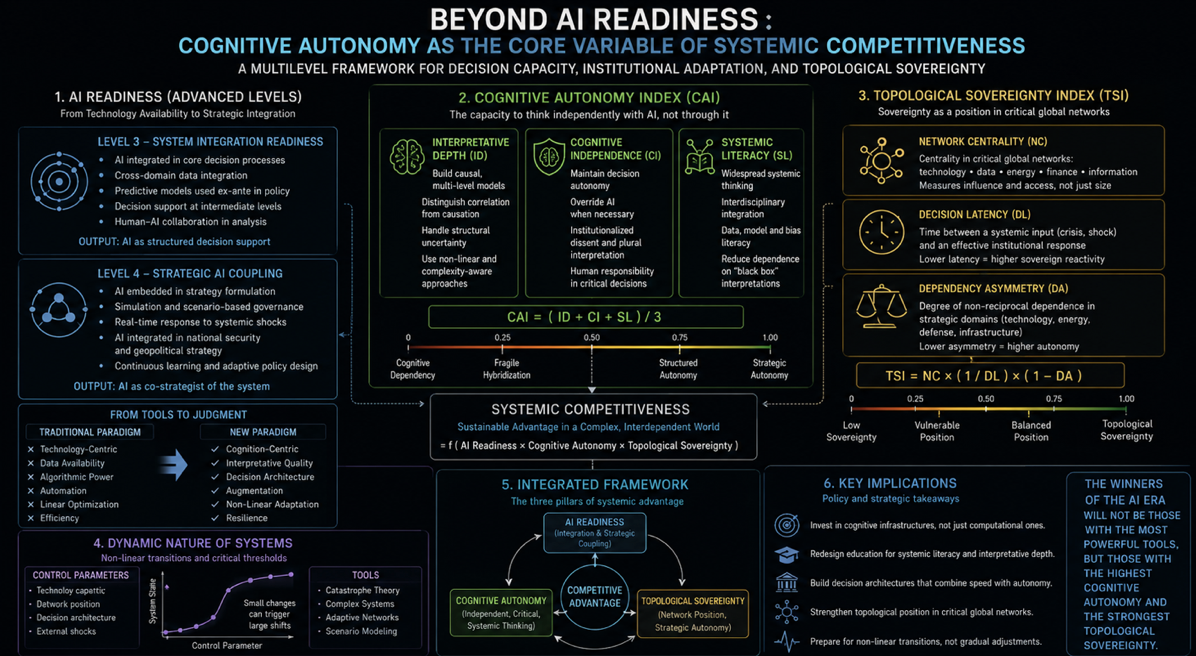

Beyond AI Readiness: Cognitive Autonomy as the Core Variable of Systemic Competitiveness
Abstract
This essay offers a critical reexamination of the concept of “AI readiness,” shifting the focus from technological indicators to the cognitive capacity of political and institutional systems to manage complexity. By introducing the concept of “cognitive autonomy,” the analysis highlights how the quality of decisions depends less on computational power and more on the ability to construct multilevel interpretive models. From this perspective, the Western educational system appears structurally unable to bridge the gap by 2035. Extending the model to the geopolitical level introduces notions of topological sovereignty and nonlinear dynamics interpretable through catastrophe theory, outlining a framework in which global competition shifts from the technological dimension to the cognitive and decision-making dimensions
1. The Two Questions No One Really Asks
Recently, following a discussion about one of my works, I was asked two questions that, rather than requiring a technical answer, raise a structural issue.
The first concerns how to concretely measure Levels 3 and 4 of AI readiness in organizations and national systems.
The second, on the other hand, concerns the possibility that the Western education system might, by 2035, reduce the cognitive autonomy gap—that is, the autonomous capacity for analytical and decision-making processes in the face of increasingly pervasive artificial intelligence systems.
These two questions share a common element: they shift the focus of the problem from technological innovation to the cognitive capacity of social and institutional systems.
This is a significant shift in perspective. Because it implies that the issue is not how powerful AI will become, but rather how well the systems that use it will be able to understand, govern, and integrate it into complex decision-making processes.
2. The Western Misunderstanding of “AI Readiness”
Much of the contemporary debate measures “readiness” for artificial intelligence through predominantly technological indicators: computing infrastructure, investment in research, the number of patents, and data availability.
These are useful indicators, but they are incomplete. They describe the availability of the technology, not the strategic capacity to use it.
The critical point is that “AI readiness,” as it is generally understood, tends to confuse the power of the tool with the maturity of the system that uses it.
A system can be highly advanced from a technological standpoint and, at the same time, fragile from a cognitive and decision-making standpoint.
In other words: it can possess artificial intelligence without possessing interpretive autonomy.
3. The Hidden Variable: Cognitive Autonomy
The concept of cognitive autonomy introduces a fundamental distinction: the difference between access to information and the ability to construct multilevel interpretive models.
A system with a high degree of cognitive autonomy is capable of:
- integrate heterogeneous information;
- construct causal models, not merely descriptive ones;
- operate under conditions of structural uncertainty;
- distinguish between correlation and strategy;
- use AI as an amplifier rather than a substitute for reasoning.
In this context, artificial intelligence does not reduce the need for critical thinking; rather, it enhances it.
The paradox is clear: the more the computational capacity of systems grows, the more the value of human and institutional capacity to correctly interpret the results increases.
The quality of decisions does not increase linearly with the power of the tools, but with the quality of the cognitive model that governs them.
4. The Structural Limitation of Contemporary Education
The question of whether the Western education system can bridge this gap by 2035 requires a deeper assessment of the very nature of education.
The current educational model is, for the most part, still centered on:
- sequential learning;
- vertical specialization;
- standardized assessment of competencies;
- the separation between analytical and systemic disciplines.
This model is hardly compatible with the need to develop real-time, multilevel analytical skills.
Building cognitive autonomy, on the other hand, requires:
- systems thinking;
- modeling skills;
- interdisciplinary integration;
- familiarity with the theory of uncertainty and complex systems;
- the ability to interpret nonlinear dynamics.
In this sense, the problem is not merely educational, but structural.
It is not just a matter of introducing new disciplines, but of redefining the very form of thought that the educational system produces.
5. The Problem of Decision-Making Speed in Political Systems
Another factor concerns the relationship between cognitive capacity and the decision-making structure of political systems.
Technological transformation requires very rapid adaptation. However, contemporary democratic systems are often characterized by:
- distributed decision-making processes;
- strong influence of electoral consensus;
- short political cycles;
- high sensitivity to public communication.
These elements are not limitations in and of themselves, but they affect the speed with which a strategic vision can be translated into coherent action.
In this context, some political systems characterized by greater decision-making centralization can, at least in theory, translate strategic understanding into operational policies more quickly.
This is not a value judgment, but a structural observation: the speed of institutional adaptation does not necessarily correspond to the quality of the system, but rather to its decision-making architecture.
6. Conclusion: Toward a Theory of Decision-Making in the Age of AI
The initial questions regarding AI readiness and cognitive autonomy therefore do not concern two separate domains, but rather two sides of the same problem.
The real question is not how advanced artificial intelligence is, but how advanced the cognitive and institutional systems that utilize it are.
In this sense, the challenge of the coming years will not be technological, but both epistemological and political.
It is not merely a matter of building smarter systems, but of building systems capable of distinguishing between computational intelligence and strategic understanding.
The critical issue, then, becomes the ability to develop a theory of decision-making suited to a context characterized by global interdependence, systemic complexity, and technological acceleration.
It is in this direction that the ongoing formalization work is situated: not as an abstract theoretical exercise, but as an attempt to define an interpretive framework capable of understanding and governing the transformation currently underway.
Because, ultimately, the question is not how powerful artificial intelligence will be.
The question is who will be able to understand what to do with it.
7. Operationalization of AI Readiness and Cognitive Autonomy
The need to translate the concepts of AI readiness and cognitive autonomy into operational analytical tools stems from a specific requirement: to move beyond the purely interpretive dimension of the debate and introduce criteria that allow for a comparative assessment of different systems.
From this perspective, the goal is not to reduce complexity to simplistic indicators, but to construct a minimal framework capable of distinguishing qualitatively different levels of technological, cognitive, and institutional maturity.
7.1 AI Readiness (Levels 3–4) — Operational Indicator
AI readiness, understood in an advanced sense, does not coincide with the mere availability of technological infrastructure or with a system’s degree of digitization. Rather, it describes the level of integration of artificial intelligence into actual decision-making processes.
Level 3: System Integration Readiness
Level 3 represents a phase in which artificial intelligence is no longer confined to isolated experimental or operational functions but begins to be integrated into intermediate decision-making processes.
At this stage, AI acts as a structured decision-support tool, contributing to the analysis of complex data and the cross-cutting interpretation of economic, social, and organizational phenomena. Its presence is evident in its ability to link different domains of information and to provide predictive tools that can be used ex ante in policy or management processes.
Level 4: Strategic AI Coupling
Level 4, on the other hand, represents a qualitatively different threshold. Here, artificial intelligence does not merely support decisions but enters the realm of their strategic formulation.
At this stage, institutional systems use advanced simulation models capable of generating alternative scenarios and supporting decisions under conditions of systemic uncertainty. AI thus becomes part of the strategy-building process, influencing not only execution but also the definition of objectives.
In short, we move from AI as an optimization tool to AI as a co-strategist within the system.
7.2 Cognitive Autonomy Index (CAI)
Alongside AI’s integration capabilities, it becomes essential to measure the degree of cognitive autonomy of the human-institutional system that uses it. The Cognitive Autonomy Index (CAI) addresses this need, structured around three fundamental dimensions.
Interpretative Depth (ID)
The first dimension concerns interpretive depth—that is, the ability to construct multilevel causal models and not reduce complexity to simple correlations. A system with high interpretative depth is capable of understanding complex phenomena through nonlinear frameworks, maintaining a coherent level of explanation even under conditions of high uncertainty.
Cognitive Independence (CI)
The second dimension concerns decision-making autonomy with respect to artificial intelligence systems. A system with high cognitive independence does not merely passively accept algorithmic instructions but is capable of exercising structured forms of human override, while maintaining the capacity for institutional dissent when necessary.
Systemic Literacy (SL)
The third dimension concerns the spread of systemic competence within the decision-making and social apparatus. It is therefore not an elitist competence, but rather a widespread ability to understand complex dynamics, use advanced analytical tools, and reduce dependence on opaque or “black box” interpretive models.
7.3 Operational Summary
The Cognitive Autonomy Index can be expressed concisely as the average of the three components:
CAI = (ID + CI + SL) / 3
The resulting value allows systems to be placed along a continuum ranging from forms of structural cognitive dependence to states of advanced cognitive autonomy.
7.4 Topological Sovereignty Index (STI)
In a context characterized by technological and informational interdependence, the dimension of sovereignty can no longer be interpreted in exclusively territorial or formal terms. Instead, it takes on a relational and positional nature, which can be described through the concept of topological sovereignty.
The Topological Sovereignty Index (STI) aims to operationalize this insight by combining three fundamental dimensions.
Network Centrality (NC)
A system’s centrality within critical global networks—technological, energy, information, and industrial—determines its ability to influence, rather than merely be subject to, systemic dynamics.
Decision Latency (DL)
A second factor concerns decision-making latency—that is, the time required for a crisis-related input to be translated into an effective political or institutional response. The shorter this latency, the greater the system’s ability to maintain active control over events.
Dependency Asymmetry (DA)
Finally, dependency asymmetry measures the degree to which a system depends on other actors in a non-reciprocal manner, in strategic areas such as technology, energy, or digital infrastructure.
7.5 Operational Summary
In summary, the STI can be expressed as:
STI = NC × (1 / DL) × (1 – DA)
This indicator allows sovereignty to be represented not as a static attribute, but as a dynamic function of the system’s position within global networks.
8. Emerging Systems, Topological Sovereignty, and Nonlinear Transitions
If we extend this interpretive framework to the geopolitical level, the concept of AI readiness cannot be separated from the ability of state systems to redefine their position within interdependent networks.
From this perspective, certain actors are demonstrating a particular capacity for adaptation—not so much due to the availability of technological resources, but rather because of the speed with which they can realign their decision-making structures and strategic vision.
The United Arab Emirates, Saudi Arabia, and India are examples where centralized decision-making and a clear strategic direction can translate into faster positioning within new global technological and cognitive ecosystems. China, in this context, appears as a hybrid system: deeply structured on the industrial and technological levels, but still in the process of reconfiguring its decision-making and interpretive models inherited from earlier stages of its development.
These dynamics cannot be understood through linear geopolitical models.
This is where it becomes useful to introduce the concept of topological sovereignty, understood as an emergent property of political and institutional systems that does not depend exclusively on territorial boundaries or formal attributes, but on the relative position that these systems occupy within technological, financial, informational, and cognitive networks.
In systems of this kind, transitions are not gradual but often nonlinear. Small variations in the ability to interpret complexity or to integrate artificial intelligence into decision-making processes can produce sudden qualitative changes.
In this sense, catastrophe theory offers a conceptual lens particularly suited to describing such discontinuities: not as exceptions, but as a structural mode of evolution in complex systems.
Contemporary geopolitics, viewed through this lens, no longer appears as a sequence of successive equilibria, but as a system of critical thresholds and state transitions.
It is in this space that the cognitive dimension becomes a primary strategic variable: because what determines a system’s position is not only its material strength, but its ability to consciously navigate these discontinuities.
Foundational Bibliography for the Framework
1.Shannon, C. E. (1948), A Mathematical Theory of Communication.
Foundations of information theory. Introduces the concept of information as a measurable entity, serving as the structural foundation for interpreting the relationship between data, noise, and decision-making capacity in complex systems.
2.Wiener, N. (1948), Cybernetics: Or Control and Communication in the Animal and the Machine.
The origins of cybernetic theory. Essential for understanding feedback systems, self-regulation, and the relationship between control and information in social and technological systems.
3.Ashby, W. R. (1956), An Introduction to Cybernetics.
Introduces the law of requisite variety: a system can control another only if it possesses equivalent or greater internal variety. Central to the concept of AI readiness and cognitive autonomy.
4.Simon, H. A. (1969), The Sciences of the Artificial.
Defines designed systems as adaptive systems. Fundamental to the distinction between natural, artificial, and institutional intelligence in decision-making processes.
5.Thom, R. (1972), Structural Stability and Morphogenesis.
Introduction of catastrophe theory as a model of nonlinear transitions in dynamic systems. A basis for interpreting geopolitical and institutional discontinuities.
6.Prigogine, I. (1997), The End of Certainty.
Theory of systems far from equilibrium. Introduces the idea that instability and nonlinearity are structural conditions of the evolution of complex systems.
7.Holland, J. H. (1995), Hidden Order: How Adaptation Builds Complexity.
Theory of adaptive agents and emergent complex systems. Fundamental to understanding geopolitical systems as evolving networks.
8.Barabási, A.-L. (2002), Linked: The New Science of Networks.
Theory of complex networks. Supports the “topological” interpretation of sovereignty as a relational position within global networks.
9.Castells, M. (1996–2010), The Information Age: Economy, Society, and Culture.
An introduction to the networked society. Essential for understanding the transformation of sovereignty in a global informational context.
10.Acemoglu, D., Robinson, J. A. (2012), Why Nations Fail.
The link between institutions, decision-making capacity, and development trajectories. Useful for the political-institutional component of your theory.
11.Tegmark, M. (2017), Life 3.0.
Reflections on the impact of AI as an autonomous cognitive system. Useful for the transition from AI as a tool to AI as a systemic actor.
12.National Intelligence Council (2021), Global Trends 2040.
Scenario analysis on geopolitical fragmentation and systemic competition. Empirical support for a multilevel interpretation of global dynamics


