


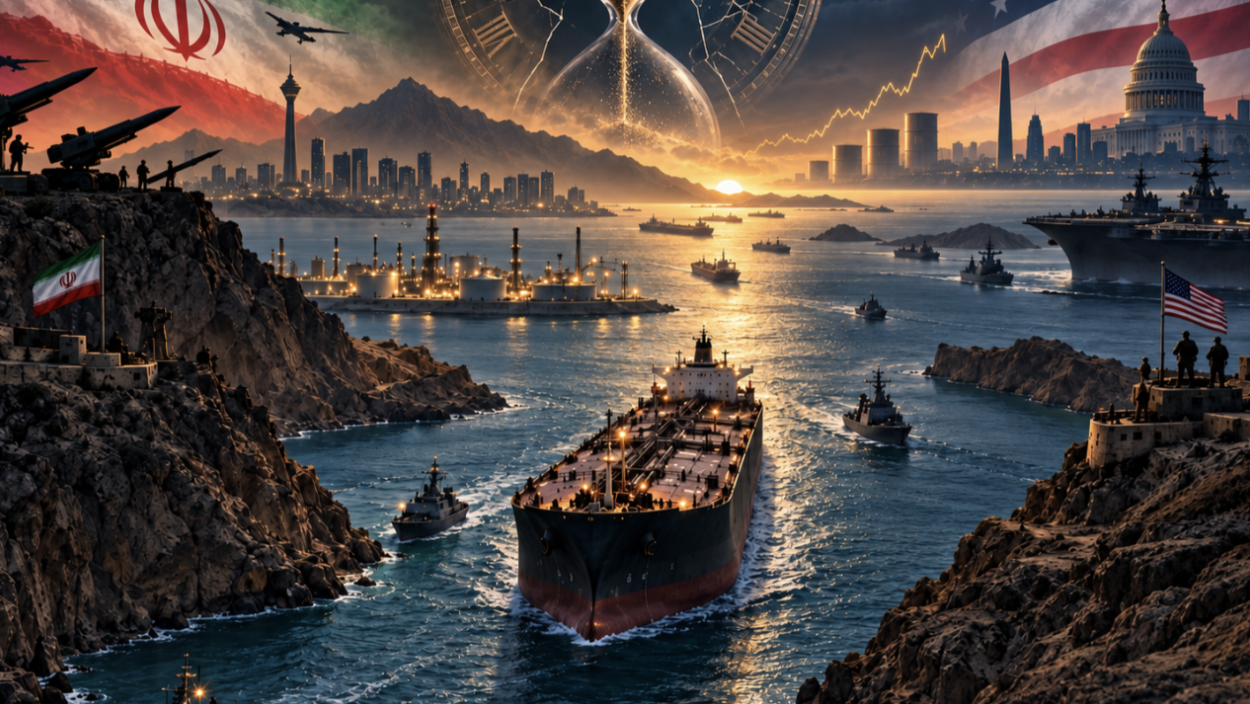

Iran–United States: Why Is Tehran Taking the Risk of Provoking Washington
No one will have missed that Tehran is provoking Washington.
At first glance, Iranian strategy may seem difficult to understand. Facing a vastly superior military power, why would Tehran continue to provoke the United States? Why take the risk of a new escalation when the Iranian economy is already under pressure and the military balance of power appears to be in Washington’s favor? One could see this as a headlong rush—a sort of race toward a wall. But another interpretation is possible: Iran may not necessarily be seeking to win a military confrontation against the United States. Instead, it might be trying to make such a confrontation costly enough to force Washington to reconsider its strategy. The difference is important.
Iran knows it cannot win a conventional war
We must start from a simple reality. Iran does not possess the military means to directly rival the United States. A prolonged conventional confrontation would be extremely unbalanced. Tehran knows this. Its objective therefore probably cannot be to defeat Washington militarily. It is more about shifting the arena of confrontation. Missiles, drones, the Strait of Hormuz, American bases in the region, maritime routes, pressure on Gulf countries and oil prices: Iran still has several tools to raise the cost of confrontation. This logic could be summed up as follows: you can hit us much harder than we can hit you, but how much are you willing to pay to keep going? It is a strategy of cost coercion.
The war of clocks continues
This logic matches what I have previously called the “war of clocks.” In a prolonged conflict, military power is not the only decisive factor. One must also look at who can better bear the cost of time. Washington has considerable military superiority, but the United States is a democracy. Public opinion, human losses, energy prices, and electoral deadlines come into play. Iran operates differently. Its regime has a much greater ability to control information, suppress protests, and impose economic and social costs on its population. For a long time, this suggested that time favored Tehran. But this hypothesis deserves reconsideration today.
And what if the Iranian clock is also speeding up?
That may be the most significant change. Sanctions, economic difficulties and military pressure can gradually reduce Iran’s room for maneuver. Another question remains: will Tehran’s traditional tools of pressure remain as effective in the future? If military capabilities decline, regional networks weaken, oil revenues become harder to mobilize, and Iran’s economic partners grow more cautious, time may start to work against Tehran. Iran’s logic could then change. Yesterday: we can wait longer than Washington. Today: if we wait too long, we will negotiate tomorrow from an even weaker position. This could explain some of the current risk-taking.
The paradox of weak escalation
We then arrive at an interesting paradox. We usually imagine that a state becomes more dangerous as it becomes stronger. But sometimes the opposite is true. A state that feels its leverage gradually disappearing may be tempted to use it before it loses its effectiveness. This is what could be called the paradox of weak escalation: the more an actor thinks its position will worsen tomorrow, the more it may be tempted to take risks today. Iran, therefore, may not be provoking Washington because it suddenly feels stronger. It might do so precisely because it feels more vulnerable. This distinction profoundly changes how we read the conflict.
Building leverage before negotiating
There is another hypothesis as well. Tehran knows that entering into negotiations from a position of great weakness risks turning talks into negotiations on terms dictated by Washington. It therefore needs to recreate leverage. The Strait of Hormuz plays a central role here. A few incidents are sometimes enough to raise the risk on oil, worry Gulf states, disrupt maritime insurance, and remind that Iranian instability can have a global cost. The strategy could be: military pressure → regional anxiety → economic disruption → international pressure → negotiation. In this scenario, escalation is not an alternative to diplomacy. It paradoxically becomes a tool of diplomacy. Tehran would be seeking to improve its position before returning to the negotiating table.
But how far can escalation be calibrated?
This is obviously where this strategy becomes extremely dangerous. It rests on the idea that each side understands the other’s limits. Iran strikes hard enough to worry Washington, but not so hard as to provoke a response that could directly threaten the regime. The United States strikes hard enough to weaken Iran, but without wanting to trigger an uncontrollable regional war. This escalation may seem rational. In reality, it depends on many variables. A missile that misses its target is one event. The same missile causing heavy American losses can become a strategic turning point. A limited attack on oil infrastructure can be seen as a warning. An attack that disrupts global supply can trigger a much larger response. As strikes and counterstrikes multiply, the gap between controlled coercion and uncontrolled war narrows.
A rational strategy can produce an irrational outcome
This may be the real danger. Neither Iran nor the United States needs to want full-scale war for it to become possible. Each side can act rationally according to its own logic. Washington wants to show that pressure works. Tehran wants to show it cannot be strangled without consequences. Washington then increases the pressure. Tehran raises the cost of this pressure. And each believes the other will eventually back down. The problem begins when both adversaries reach the same conclusion at the same time: backing down now would be politically more dangerous than continuing. At that point, escalation can take on its own momentum.
Is Tehran heading for the wall?
Not necessarily. Iran may instead be trying to convince Washington that a wall lies ahead for both adversaries. Its message could be quite simple: the United States can win militarily, but that victory carries a much higher economic, regional and political cost than expected. Iran’s strategy is thus to make this cost credible. But it is a huge gamble. Because the more Tehran uses its remaining levers to show it is still dangerous, the more it simultaneously increases the likelihood of an American reaction aimed precisely at removing those levers.
That is the paradox. Iran may not be provoking the United States because it believes it can win the war. It provokes because it still wants to influence the conditions under which that war could end. And if this hypothesis is correct, the central question may no longer be who possesses the greatest military power. It becomes much more worrying: Who, Washington or Tehran, will be the first to judge that the cost of the next step is greater than the cost of stepping back?


