


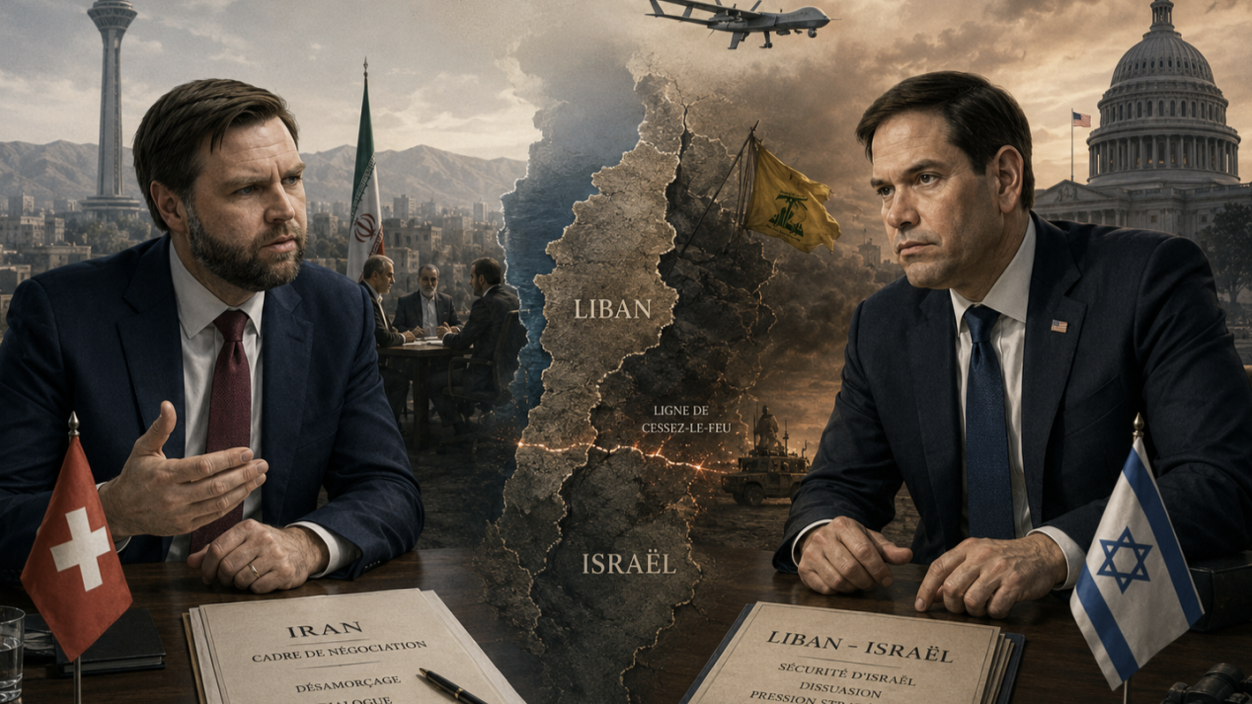

Middle East: Two Tracks, Two Doctrines
Sometimes, inside an American administration, the real divisions are not expressed openly. Officially, everyone is aligned behind the president. Officially, there is only one strategy, one line, one diplomacy. But in reality, files often speak more clearly than official statements.
This is what we are seeing today with two men, two dossiers, and perhaps two doctrines: J.D. Vance on the Iranian track, Marco Rubio on the Lebanese track.
The distribution of roles is not accidental. Vance embodies the Iranian file. He negotiates, reassures, and presents the memorandum between Washington and Tehran with cautious optimism. Rubio, meanwhile, has taken charge of the Lebanese file. He presents the Israel-Lebanon framework as a “first step,” but above all as a separate process, distinct from the Iranian deal.
At first glance, this may seem like a simple division of labor. In reality, it goes much deeper.
Vance appears to see Israel as a constraint to be managed. Rubio sees Israel as an ally whose security remains a priority. This is not just a difference of tone. It is a difference in strategic vision.
Vance comes from the America First restraint wing, more cautious, more suspicious of foreign commitments, and more sensitive to the idea that the United States must avoid being dragged into another regional war. In this logic, Israel cannot enjoy unlimited freedom of action if that freedom threatens an agreement with Iran.
Rubio comes from a more traditional Republican foreign policy school, more interventionist, more attached to Israel, and more hostile to Iran. For him, Hezbollah remains first and foremost an armed threat against Israel, and the Israeli response can therefore be presented as legitimate, even if it complicates American diplomacy.
So the real divide is not between a pro-Israel figure and an anti-Israel figure. That would be too simplistic. The divide is elsewhere: should Israel be restrained in order to protect the Iranian deal, or should Israel’s autonomy be preserved even if it makes the agreement with Tehran more fragile?
This is where Lebanon becomes the decisive point.
Since October 7, 2023, Israel has profoundly changed its doctrine. It no longer wants only to respond to attacks. It wants to prevent threats from being rebuilt. It no longer wants to wait until fronts are reactivated. It wants to strike before the enemy regains the initiative. This doctrine applies in Gaza, against Iran, and of course against Hezbollah in Lebanon.
For Tehran, the Lebanese front is essential. Hezbollah is not just an ally. It is a strategic instrument. It is Iran’s military depth on Israel’s northern border. If the United States manages to impose a ceiling on Israeli action in Lebanon, then Iran gains a major advantage without having to win it on the battlefield.
That is the heart of the issue.
If the Lebanese file is integrated, even indirectly, into the memorandum with Iran, then Tehran may obtain an American constraint on Israel before making any truly verifiable nuclear concession. This is what could be called an advance gain. Iran obtains de-escalation on the front that protects its main regional proxy, while its own commitments remain delayed, technical, gradual, and open to interpretation.
This is exactly the logic of front-loading: receive now, promise later.
In this reading, Vance objectively serves the logic of the Iranian deal. He wants to prevent Israeli strikes in Lebanon from destroying the diplomatic architecture Washington is trying to build with Tehran. His reasoning is coherent: if the priority is to avoid a regional war, then all actors must be contained, including Israel.
But from the Israeli point of view, this logic is dangerous. It means that Israel’s freedom of action against Hezbollah could now depend on an agreement between Washington and Tehran. In other words, Israel may find itself limited not by its military capabilities, but by an American diplomacy over which it has little control.
Rubio is trying precisely to prevent that. By insisting that the Lebanese file is separate, he protects the idea that Lebanon remains a distinct theater, that Hezbollah remains a specific threat, and that Israel’s military autonomy must not be absorbed into the Iranian deal.
This is why the Vance-Rubio rivalry goes beyond personalities. It reflects a broader internal battle in Washington: what should America’s priority be in the Middle East? Stabilize the region through a compromise with Iran, even if that means restraining Israel? Or preserve Israel’s strategic superiority, even if that makes the Iranian agreement more fragile?
This divergence is even more important because it already fits into the 2028 political horizon. Vance and Rubio are not only two officials inside the administration. They are also two possible figures of the post-Trump era. Each speaks to a different part of the Republican camp. Vance speaks to the non-interventionist base, tired of distant wars and convinced that America must first protect itself. Rubio speaks to the more traditional camp, more Atlanticist, more attached to Israel, and more hostile to Iran.
The Iranian file may become Vance’s signature. The Lebanese file may become Rubio’s marker.
That is why official denials are not enough. The more an administration insists that it is perfectly aligned, the more we should look at the lines of tension. And here, they are visible.
The question, therefore, is not who will win between Vance and Rubio. The real question is which track will absorb the other.
If Rubio’s line prevails, Lebanon remains a separate file. Israel keeps a margin of action against Hezbollah. The memorandum with Iran does not become an instrument to limit Israel’s new doctrine.
If Vance’s line prevails, then Lebanon will gradually be reintegrated into the logic of the Iranian deal. In that case, Tehran will have obtained through Washington what it did not obtain through arms: a political brake on Israeli military autonomy.
This may be the real test of the moment.
The Iranian deal will not be decided only on uranium enrichment, sanctions, or oil. It will also be decided in Lebanon, on Israel’s northern border, where we will see whether Washington still protects Israeli freedom of action, or whether that freedom becomes an adjustment variable in the broader negotiation with Tehran.
The Israeli drone strike after the signature is therefore not a detail. It is a message. Israel is testing the limit. Washington is testing its own coherence. And Iran is watching.
Because in the end, the question is simple: is Lebanon a separate file, or has it already become the hidden currency of the Iranian deal?


