


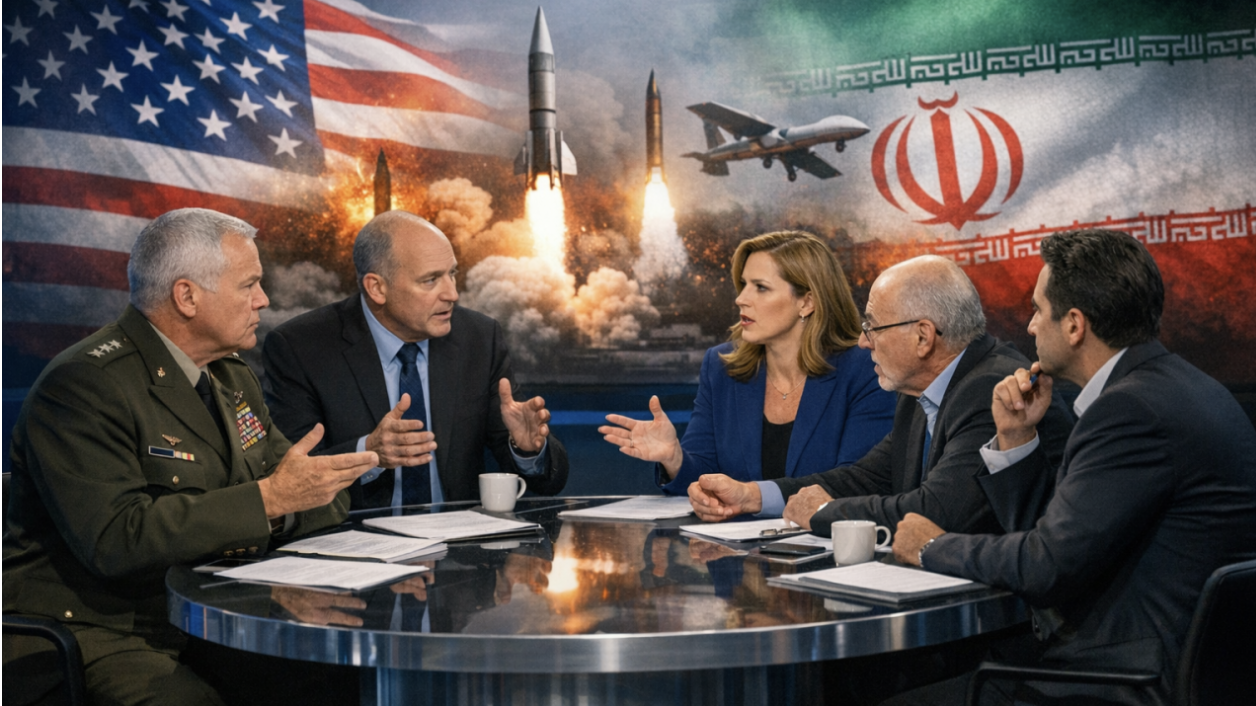

Middle East: War, expertise, and confusion.
While watching news platforms dedicated to the war between the United States and Iran, I found myself experiencing a paradoxical feeling: the more experts spoke, the less clear the situation seemed. By hearing contradictory certainties, the simple spectator ends up not enlightened, but slightly confused.
A parallel performance plays out on television screens worldwide as the conflict between the United States and Iran takes center stage. A parallel show unfolds on television sets around the world. Retired generals, former diplomats, consultants, self-proclaimed experts, and specialists in the region or strategy all speak, interpret, and announce. But there’s still a malaise. The situation appears less readable as the number of speakers increases. The viewer’s comprehension of what is truly being played decreases with the number of comments.
This malaise is not trivial. It reveals an increasingly profound confusion between two exercises yet distinct: analysis and opinion.
In a war, especially in the Middle East, uncertainty is not an accident of comment. It is at the very heart of reality. The intentions are concealed. The signals are confusing, and the actors lie, test, bluff, retreat, advance, and negotiate while bombing. In such an environment, the role of an analyst is not to distribute instant certainties. His role is to bring clarity to the confusion. He should not say, “This is what will happen. “He should say: ‘Here is what we know, here is what we ignore, these are the plausible scenarios, these are the variables that will change the course of events.’
Yet it is precisely this work that television platforms support less and less.
Contemporary television rewards less rigor than speed, less caution than formulas, less method than presence. The guest expert must speak, decide, and summarize quickly. It must give the impression of mastering a situation that, in reality, partly escapes all the actors themselves. The problem is therefore not only the quality of certain stakeholders. The problem is structural: the media format itself pushes to transform analysis into performance.
This is how we see a strange inflation of certainties in situations where humility should be the first virtue. One states that Washington is already seeking regime change. The other argues instead that the US only wants to destroy Iran’s nuclear capabilities. A third explains that Tehran is bluffing. A fourth assures that Iran is ready for total regional escalation. Often, everyone speaks as if their hypothesis were a fact. Very few take the trouble to expose several possibilities in parallel.
It is here that one must recall a simple thing: an analyst is not a prophet. He’s not here to pander to the audience’s psychological need for a definitive answer. He’s here to map uncertainty.
Analyzing is not imposing an opinion. It is prioritizing hypotheses. It is distinguishing between observable facts and supposed intentions. It is separating the real capabilities from the communication postures. It is to integrate economic, military, diplomatic, and psychological constraints. In other words, analysis is not the removal of doubt. It is its organization.
In the case of a war between the United States and Iran, this requirement should be absolute. Because it is not just about who hits whom. It is necessary to understand what Washington really seeks: to punish, dissuade, negotiate from a position of strength, or more deeply redraw the regional balance? We must ask ourselves what Tehran is looking for: to survive, retaliate, internationalize the crisis, buy time, or preserve the continuity of the regime at all costs?. It is also necessary to take into account the peripheral actors, often underestimated on the plateaus: the Gulf monarchies, Israel, China, Russia, energy markets, Western public opinions, and the European allies themselves.
A modern war is never purely military. It is also narrative, economic, energetic, and psychological. Reducing the conflict to a succession of strikes and retaliations, it is already poorly understood.
What troubles the viewer, deep down, is often less the error than the lack of a visible method. When an expert speaks, he should show his reasoning. On what does his judgment rest? What facts does he take seriously? What hypotheses does he discount? What could invalidate his reading? Without this intellectual architecture, there remains only one assured voice, that is to say, an opinion among others.
And this is perhaps the heart of the contemporary problem: media authority is increasingly confused with analytical solidity. Because a speaker speaks in a firm tone, with strategic vocabulary and military references, the audience assumes that he is analyzing. But the form of speech does not guarantee its quality. An opinion dressed in technical language remains an opinion.
This drift has consequences. It blurs the public’s understanding. It creates the illusion that geopolitics is a contest of personal intuitions. It discredits the real analysts, those who agree to say, “I don’t know yet,” or “Several trajectories remain open.” And it promotes a culture of commentary where the one whose nuances seem weak, while the one who affirms seems competent.
It’s the opposite of reality.
In major crises, the best analysts are often those who resist the temptation to conclude too quickly. Not out of cowardice, but discipline. They know that war is the reign of incomplete information, deliberate manipulation, and contradictory signals. They also know that a good analysis is not the one that reassures but the one that helps to think correctly.
The spectator, on his side, must relearn to listen differently. The right question is not: «Does this expert have a strong opinion?» The right question is: «Does he show me several scenarios?” Does he distinguish between facts and hypotheses? Does he explain what could prove him wrong?» If the answer is no, then it is probably not an analysis but a comment.
Basically, the war between the United States and Iran also reveals another war, more discreet: that between thought and spectacle. On sets, the show often wins. To see the world as it is, not as it’s told, one must defend analysis against disguised opinion.
Because in times of crisis, true seriousness does not consist of speaking with certainty. It consists of thinking methodically.


