



U.N. New York declaration 2025 and Hamas… and now?
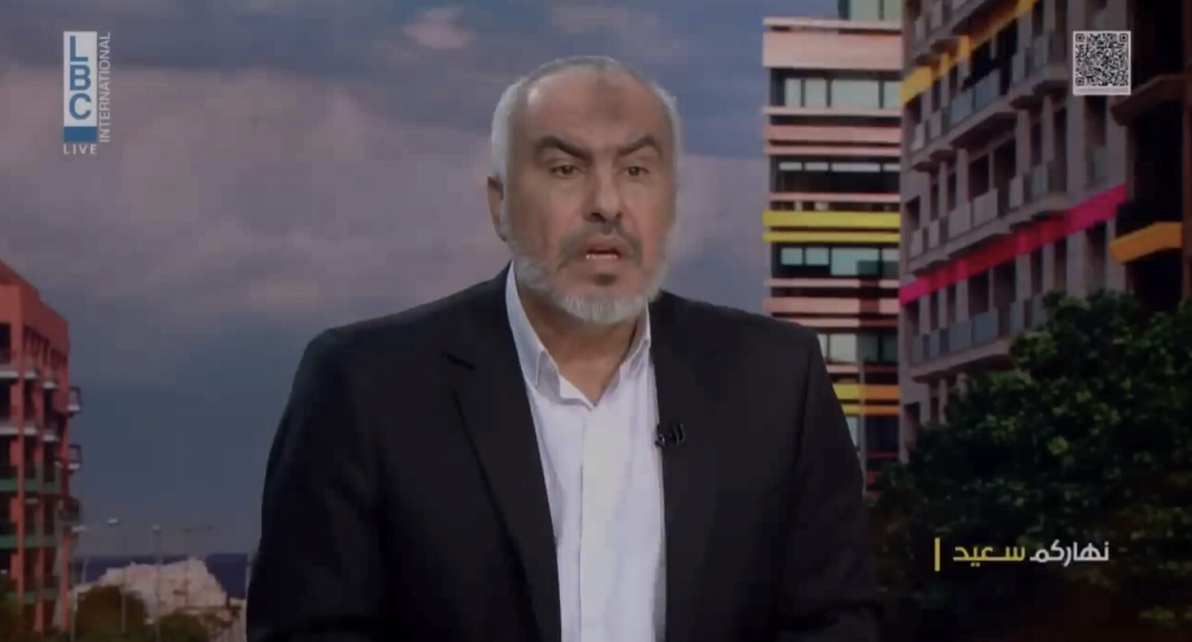
Hamas official Ghazi Hamad: “We will repair the October 7 attack, time and again, until Israel is annihilated; we are the victims-everyting we do is justified.
Source: LBC (Lebanon)
Ghazi Hamad of the Hamas political bureau said in an October 24, 2023 show on LBC TV (Lebanon) that Hamas is prepared to repeat the October 7 “Al-Aqsa Flood” Operation time and again until Israel is annihilated. He added that Palestinians are willing to pay the price and that they are “proud to sacrifice martyrs.” Hamad said that Palestinians are the victims of the occupation, therefore no one should blame them for the events of October 7 or anything else, adding: “Everything we do is justified.”
Ghazi Hamad: “Israel is a country that has no place on our land. We must remove that country, because it constitutes a security, military, and political catastrophe to the Arab and Islamic nation, and must be finished. We are not ashamed to say this, with full force.
“We must teach Israel a lesson, and we will do this again and again. The Al-Aqsa Flood is just the first time, and there will be a second, a third, a fourth, because we have the determination, the resolve, and the capabilities to fight. Will we have to pay a price? Yes, and we are ready to pay it. We are called a nation of martyrs, and we are proud to sacrifice martyrs.
“We did not want to harm civilians, but there were complications on the ground, and there was a party in the area, with [civilian] population…. It was a large area, across 40 kilometers…
“The occupation must come to an end.”
News anchor: “Occupation where? In the Gaza Strip?”
Hamad: “No, I am talking about all the Palestinian lands.”
News anchor: “Does that mean the annihilation of Israel?”
Hamad: “Yes, of course. (…)
“The existence of Israel is illogical. The existence of Israel is what causes all that pain, blood, and tears. It is Israel, not us. We are the victims of the occupation. Period. Therefore, nobody should blame us for the things we do. On October 7, October 10, October 1,000,000 – everything we do is justified.”
The above blatantly flies in the face of what happened recently at the UN with reference to the “UN Declaration on the “Peaceful Settlement of the Question of Palestine and the Implementation of the Two State Solution” (July 30, 2025), a declaration emerged from a high-level international conference focused on the Israeli-Palestinian conflict and the two-state solution, wich has emphasized the need for collective action to end the war in Gaza, ensure Israel’s withdrawal, and transfer control to the Palestinian Authority.
The document, which is notable for its emphasis on the need for a solution political solution based on international law and the two-state solution, which is seen as the only way to achieve a just and lasting peace acquires particular relevance in that among the various steps contemplated it gives a central role to the establishment of a transitional administrative committee in Gaza, under the aegis of the Palestinian National Authority ousting altogether Hamas whose action is condemned without ifs and buts, to the point of demanding its total disarmament.
Specifically, the signing of the aforementioned document by many Arab countries, beginning with those that have long opposed Hamas or consider the group a political enemy, acquires particular significance.
In first place among the signatories are the United Arab Emirates (UAE) and Bahrain, that is, two of the very few Arab countries that not only condemned in no uncertain terms the Oct. 7 attack and called Hamas a terrorist organization equivalent to that of the Muslim Brotherhood, but made it a condition for any support for the reconstruction of Gaza that Hamas be demilitarized and the group be excluded from any governing body in the region : a position, the latter, fully shared by a Saudi Arabia that, in no small measure fearing the expansion of Iranian influence via Hamas and the group’s ideological closeness to the Muslim Brotherhood, an organization by the way banned in Arabia, on July 30, 2025, publicly condemned Hamas, whose disbanding, disarmament with the concomitant transfer of power to the Palestinian Authority was demanded .
A similar position has been taken by Egypt, which, involved in various capacities in mediation between Fatah and Hamas, has seen fit to support the need to reduce the role of Hamas by proposing what has been described as a more composite path regarding the future role of Hamas.
A no different position in form, but not in substance, has been that taken so far even by Jordan, which, although it has long avoided openly criticizing Hamas for fear of possible internal destabilization, given the millions of Palestinians residing in Jordan and political pressure from the local Islamist scene, eventually took a strongly antagonistic stance, calling for the group’s disarmament and the transfer of power to the Palestinian Authority, as well as rejecting outright plans to relocate Gaza’s civilian population within its borders
So much in a context that now sees even Qatar, -always a staunch supporter of Hamas, whose leadership it hosts in Doha, and still an active player in the ceasefire negotiations, as well as in all matters of logistical and humanitarian support in Gaza-, among those who have recently joined the UN declaration against Hamas, albeit with distinctions aimed at maintaining a more open approach to some form of political inclusion of the same .
A separate discussion deserves other countries in the region such as Kuwait, Algeria, Iraq, Tunisia, Yemen and Lebanon in that they have for some time now, in addition to strongly denouncing any attempt to relocate the population of Gaza in their territories, have firmly rejected any legitimization of Hamas, while reaffirming their unconditional support for the Palestinian cause, albeit only through institutional avenues, as Anadolu Agency significantly reported again in February 2025.
This is an official position definitely worthy of attention, but one to be treated with due caution since in the not-too-distant past precisely Iraq, Lebanon and Yemen (the Houthis) have on several occasions been noted for their alignment with Iran, and thus with the latter’s decisive pro-Hamas stance that has often resulted in expressions of solidarity with the group whose usual anti-Israel narratives it has so far shared.
Interesting in this context, then, is the examination of the position taken by Libya given the particular juncture, but not only: a Libya that has neither signed nor supported the July 30, 2025 “New York Declaration,” which, incidentally said, has not been signed by either the United States or Israel. In the specifics of the intercurrent relations between Libya and Hamas, it should then be duly emphasized that the great North African country has never supported Hamas as an organization, but only the Palestinian cause while nevertheless showing political and moral solidarity with the Palestinian people even in the contexts in which Hamas is involved.
The official position of the Libyan government is such that it does not recognize Hamas as the official representative of Palestine, while it reserves this privilege for the PLO (Palestine Liberation Organization) and maintains diplomatic relations with the Palestinian National Authority (PNA). Nonetheless, on several occasions Hamas has publicly praised Libya both for its refusal to normalize relations with Israel and for its loyal support for the Palestinian cause, which, as is well known, were two salient features of the foreign policy of the staunch pan-Arab nationalist Qaddafi until almost his death , even if at some point he ended up softening his stance toward Israel somewhat.
Regarding indirect relations there is to be said that on some occasions, Libyan militias had informal contacts or facilitated the transit of arms to the Gaza Strip, especially in the chaos following the fall of Qaddafi (2011), but it is not clear whether this was done with the approval or not of the government. Not to mention reports in some Arab and Israeli media according to which there have been instances where Hamas members have been released from Libyan jails.
But about this and what in some ways lies behind certain stances such as that of Qatar, we will deal in a paper specifically devoted to this issue also in the light of the new Jihadist course launched by al-Joulani, and by the not easily deciphered veering of the White House’s Middle East policy.
1 https://youtu.be/mPWOvwG4_x4?si=RLnVwmQnH7LcTNYz
3 https://www.israelhayom.com/2025/02/25/the-future-of-gaza-saudi-arabia-uae-demand-hamas-disarmament-egypt-and-qatar-oppose/ ; https://responsiblestatecraft.org/arab-states-gaza/ ; https://www.reddit.com/r/worldnews/comments/1iyy6f5/saudi_arabia_uae_demand_hamas_disarmament_egypt/?utm_source=chatgpt.com ; https://www.wsj.com/world/middle-east/why-arab-leaders-are-struggling-to-agree-on-hamass-future-role-in-gaza-d818a726
4 https://www.dawn.com/news/1927538
5 https://gulfnews.com/world/gulf/arab-nations-including-qatar-saudi-arabia-and-egypt-unite-to-demand-hamas-disarm-end-of-gaza-rule-1.500215749 ; https://elpais.com/internacional/2025-07-30/los-paises-arabes-piden-a-hamas-que-deje-las-armas-y-abandone-el-poder-en-gaza.html ; https://www.dawn.com/news/1927538 ; https://nypost.com/2025/07/29/world-news/qatar-saudi-arabia-egypt-join-calls-for-hamas-to-disarm-and-exit-gaza-to-end-war-with-israel/
6 https://responsiblestatecraft.org/arab-states-gaza/ ; https://www.timesofisrael.com/liveblog-february-14-2025/ ; https://www.aa.com.tr/en/middle-east/arab-nations-organizations-continue-to-express-their-opposition-to-trumps-gaza-plan/3474528 ;
7 https://gulfnews.com/world/gulf/arab-nations-including-qatar-saudi-arabia-and-egypt-unite-to-demand-hamas-disarm-end-of-gaza-rule-1.500215749 ; https://elpais.com/internacional/2025-07-30/los-paises-arabes-piden-a-hamas-que-deje-las-armas-y-abandone-el-poder-en-gaza.html ; https://www.dawn.com/news/1927538 ; https://nypost.com/2025/07/29/world-news/qatar-saudi-arabia-egypt-join-calls-for-hamas-to-disarm-and-exit-gaza-to-end-war-with-israel/
8 https://responsiblestatecraft.org/arab-states-gaza/ ; https://www.israelhayom.com/2025/02/25/the-future-of-gaza-saudi-arabia-uae-demand-hamas-disarmament-egypt-and-qatar-oppose/ ; https://www.wsj.com/world/middle-east/why-arab-leaders-are-struggling-to-agree-on-hamass-future-role-in-gaza-d818a726
10 Ronen, Yehudit (2004). “Gheddafi in Libia e il conflitto israelo-palestinese, 1969-2002”. Studi sul Medio Oriente. 40 (1): 85-98. ISSN 0026-3206″; “Yehudit Ronen, ‘Personalità e politica: Gheddafi, Nasser, Sadat e Mubarak (1969-2000)’, Journal of North African Studies, Vol.6, No.3 (2001), pp.1-10; e Shimon Shamir, L’Egitto sotto Sadat, alla ricerca di un nuovo orientamento (Tel Aviv: Dvir 1).


