



Venezuela: beyond the earthquake
Part One
When the earth stops shaking, a second emergency almost always begins. It is the one that does not immediately appear in official reports, that cannot be measured simply by counting the victims or the collapsed buildings, and that often takes weeks or months to reveal its full extent. Venezuela is currently experiencing exactly this phase.
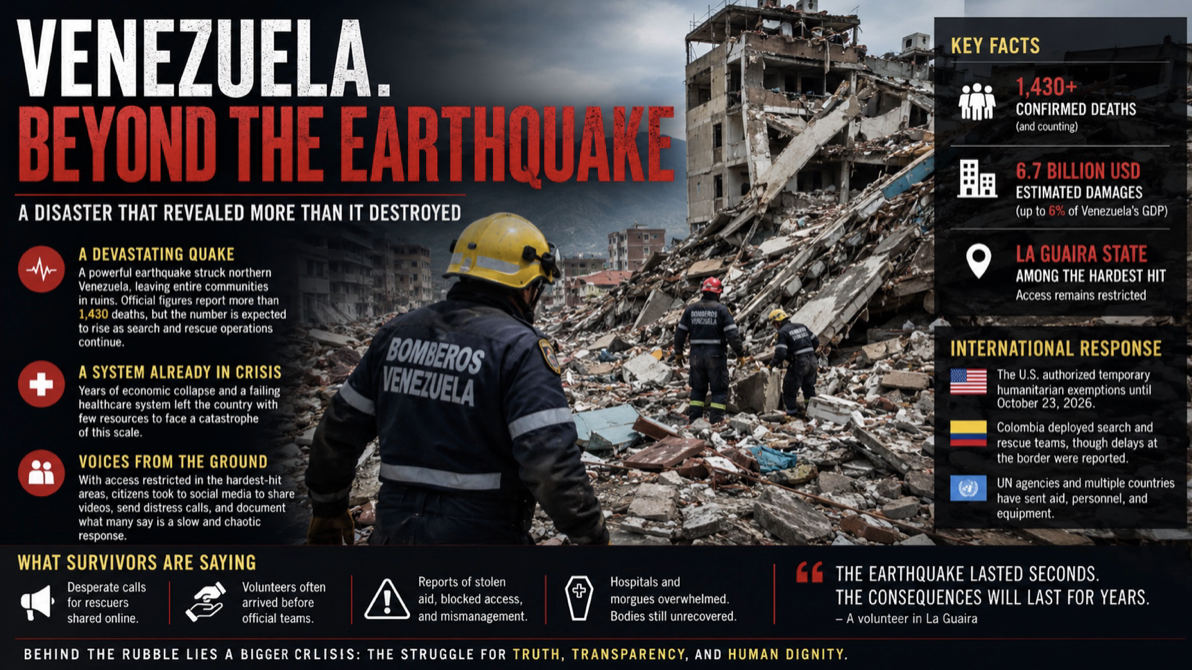
The devastating earthquake that struck the country caused widespread destruction, leaving behind devastated neighborhoods, compromised infrastructure, and a rescue operation called upon to deal with an emergency of exceptional proportions. Authorities have released an initial official death toll of approximately 1,430, a number that is inevitably set to rise as search and rescue operations continue.
The numbers, however, tell only part of the tragedy’s story.
Every major disaster, in fact, gives rise to two parallel narratives. The first is that of statistics: deaths, injuries, destroyed buildings, and economic damage. The second is much more difficult to piece together. It consists of delays, eyewitness accounts, operational decisions, fragmentary information, images circulating even before they can be verified, and questions that, in the early days, no one is able to answer with certainty.
It is precisely in this space that the Venezuelan crisis finds itself today.
From the very first hours following the earthquake, it became clear that the geography of the destruction did not coincide with that of the news coverage. Paradoxically, in the areas where the damage seemed greatest, news reports became harder to verify. In particular, in the state of La Guaira—identified by numerous sources as one of the hardest-hit areas—restrictions on access made it extremely difficult for independent observers and parts of the international press to maintain a continuous presence.
The result was immediate.
While the country was trying to organize relief efforts, the reconstruction of the facts began to follow two distinct paths. On the one hand, there were official statements, press conferences, and bulletins released by the authorities. On the other, a growing volume of images, videos, and eyewitness accounts posted directly by citizens, volunteers, and rescue workers via X, Instagram, and other digital platforms.
The two narratives do not always coincide. Sometimes they overlap. Other times, they seem to run on different tracks, making it extremely difficult to understand, moment by moment, what the actual situation is in the hardest-hit areas.
What now seems beyond dispute, however, is the scale of the disaster.
According to an initial assessment by the United Nations Development Program (UNDP), the earthquake caused an estimated $6.7 billion in damage, with a range of $4.7 to $8.7 billion, equivalent to about six percent of Venezuela’s total gross domestic product. The assessment was obtained using rapid analysis systems based on artificial intelligence, satellite imagery, and population exposure models. This is a preliminary estimate that captures only direct damage and could increase significantly once the economic effects of reconstruction, the disruption of productive activities, and the impact on infrastructure are taken into account.
However, even these figures risk being misleading if taken in isolation.
An earthquake never affects all countries in the same way. Its destructive force also depends on the condition of the territory it strikes. In Venezuela, the earthquake struck a country already deeply scarred by a long-standing economic, political, and social crisis. For years, international organizations, independent observers, and numerous journalistic reports have described a healthcare system characterized by structural deficiencies, difficulties in procuring essential medications and supplies, obsolete infrastructure, and staff forced to work under extremely challenging conditions.
An investigation published by El País a few months before the earthquake described a situation in which only four out of ten operating rooms were fully functional, and in the vast majority of hospitals, patients were asked to procure most of the materials needed for surgical procedures on their own. This was not yet the emergency caused by the earthquake. It was the norm.
It was this sense of normalcy that was shattered by the force of the earthquake.
Understanding this point is essential. The consequences of a natural disaster do not depend solely on the intensity of the tremors. They also depend on a government’s ability to respond, coordinate rescue efforts, quickly ensure the safety of survivors, provide medical care, and swiftly restore essential services.
When these capabilities are already severely compromised before the event, every hour of delay can have effects that go far beyond the initial destruction.
It is also for this reason that, as the official death toll continues to rise, a growing portion of the attention has gradually shifted from what the earthquake destroyed to how the country is dealing with its aftermath.
And this is precisely where the most difficult questions begin.
Part Two
While the first few hours after an earthquake are crucial for saving lives, they are also the hours in which every delay has an exponentially greater impact.
Images from the affected areas tell the story of a race against time. Amid collapsed buildings, blocked roads, and damaged infrastructure, rescue teams have had to operate under extremely difficult conditions. But it is precisely the speed and effectiveness of the response that, from the very first days, have been at the center of much of the controversy.
La Guaira has quickly become the symbol of this phase.
The government restricted access to the area, citing operational and security needs as the reason for the decision. While this decision may be justified in managing an emergency of such proportions, it had an inevitable effect: drastically reducing the possibility of independent observation precisely in the place where, according to numerous accounts, some of the most critical situations were concentrated.
When direct access is restricted, the weight of eyewitness accounts inevitably grows.
Thus, in the hours following the earthquake, digital platforms began to transform into a sort of spontaneous command center. X, Instagram, Facebook, and messaging groups became the places where family members sought news of their loved ones, citizens reported collapsed buildings, volunteers coordinated impromptu rescue efforts, and survivors asked for help by providing addresses, photographs, and coordinates.
It wasn’t just about recounting what was happening.
Many of those messages had an immediate, practical goal: to find someone willing to step in.
Among the most striking posts were numerous appeals in which citizens offered money to experienced rescuers in order to speed up search and rescue operations. This is a development worthy of attention not so much for the monetary value of the offers as for the significance they carry. When a population goes so far as to seek out specialized teams directly through social media, it means that time is perceived as too precious a resource to rely solely on standard emergency channels.
Those requests reveal far more than dozens of official statements ever could. They convey the fear that someone might still be alive beneath the rubble and that every minute lost reduces the chances of saving them.
At the same time, aid continued to arrive from abroad.
Several countries sent specialized personnel, K-9 units, equipment, and medical supplies. The United States decided to temporarily suspend some of the economic restrictions against Venezuela through a specific authorization from the Office of Foreign Assets Control (OFAC), allowing transactions necessary for humanitarian operations until October 23, 2026. This is an exceptional measure that underscores the gravity of the situation.
Rescue teams have also departed from Colombia.
It was precisely on this front that one of the first public controversies arose. The mayor of Medellín has denounced delays in the entry of Colombian firefighters heading to the affected areas. According to his account, bureaucratic procedures and authorizations slowed the arrival of highly specialized personnel precisely during the hours when time was of the essence for rescuing any survivors.
It is difficult to determine what the actual impact of those delays was. It is clear, however, that the incident contributed to fueling a climate of growing tension surrounding the overall management of the emergency.
The same atmosphere is evident in the images documenting Vice President Delcy Rodríguez’s visit to some of the affected areas. Several videos show scenes of intense protests by citizens complaining about the slow pace of rescue efforts and the inadequacy of the response. In some footage, whistles, shouts, and accusations directed at the authorities can be clearly heard, while some residents claim that groups of volunteers were turned away or restricted in their search efforts.
Here too, beyond the specifics of individual incidents, it is the overall atmosphere that is particularly striking. In a situation where every intervention can mean the difference between life and death, trust in institutions becomes an essential component of emergency management. When that trust is eroded, reliance on spontaneous initiatives, solidarity networks, and informal channels inevitably grows.
This is precisely what appears to have happened in numerous locations.
Alongside accounts of rescue operations, in fact, there are also much more serious reports. Videos and eyewitness accounts speak of bodies still lying in the rubble, difficulties in recovering victims, hospitals operating at the limits of their capacity, and morgues unable to quickly handle the growing number of deceased.
Other reports describe an even more critical situation: alleged thefts of humanitarian aid, interference in rescue operations, roadblocks imposed on some emergency teams, and delays in the distribution of supplies intended for the population. Numerous videos, shared primarily via X and Instagram, support these allegations by showing incidents that have quickly fueled a heated public debate.
It is significant to note that many of these reports do not come from political organizations or major media outlets, but directly from citizens, healthcare workers, volunteers, and people involved in the day-to-day management of the emergency. It is they who, through digital tools, have constructed a parallel account of the earthquake: an account that is often fragmentary, sometimes contradictory, but capable of giving voice to realities that would otherwise have remained confined within the affected areas.
In the absence of a widespread presence of independent observers, this wealth of testimonies has taken on extraordinary significance. Not because it replaces journalistic fact-checking, but because it represents the first level of understanding of what is happening on the ground. It is from these images, these accounts, and these reports that verifications, investigations, and, at times, even refutations begin.
The earthquake, therefore, continues to have consequences far beyond the moment of the tremor. Every hour adds new elements to a picture that is still incomplete. Each account contributes to a mosaic that, at least for now, remains inevitably incomplete.
And it is precisely this incompleteness that represents one of the most unsettling aspects of the entire affair.
Part Three
Every major disaster leaves behind two kinds of rubble.
The first is what everyone can see: collapsed buildings, shattered roads, damaged hospitals, families who have lost everything in a matter of seconds.
The second type is less visible, but no less dangerous. It is the rubble of information.
In Venezuela, these two dimensions seem to have overlapped from the very first hours following the earthquake. On one hand, the official account of the emergency; on the other, an unceasing stream of images, videos, eyewitness accounts, calls for help, and complaints that flooded digital platforms without waiting for journalistic verification or official statements.
This dynamic characterizes many contemporary crises, but in Venezuela it takes on a particular significance. When access to the hardest-hit areas is limited and the presence of independent observers is inevitably reduced, civil society tends to fill that void by directly recounting what it sees. Every cell phone becomes a camera. Every citizen can become a witness. Every video becomes a fragment of reality demanding to be heard.
It is in this space that the images hardest to ignore emerge.
Among the hundreds of videos circulating in the days following the earthquake are clips showing bodies still trapped in the rubble, citizens denouncing the lack of adequate resources, healthcare workers describing hospitals on the brink of collapse, volunteers claiming to have arrived before official rescue teams, and people saying they had to search for specialized rescuers on their own.
Other videos show alleged incidents of humanitarian aid being stolen, law enforcement actions contested by the public, and moments of high tension in the hardest-hit areas. These images have fueled an intense public debate and continue to circulate at a pace that is impossible to ignore.
Added to these accounts are even more dramatic stories.
Some speak of bodies left out in the open for too long, waiting to be recovered. Others describe morgues unable to accommodate all the victims. Others argue that the handling of the bodies is itself becoming a public health emergency. If these accounts accurately describe what is happening, the tragedy would take on an additional dimension: no longer just the earthquake and its victims, but the risk that the consequences of the destruction will linger over time, further exacerbating the conditions of a population already severely affected.
It is significant to note that, to date, no independent investigation has been conducted on a sufficiently large scale to systematically confirm or refute all of these reports. The result is an information vacuum that inevitably fuels questions, suspicions, and alternative accounts.
This, too, is a fact.
When a humanitarian crisis unfolds in a context where the independent collection of information faces objective obstacles, the problem is not merely determining which accounts are accurate and which are not. The problem is that the absence of timely verification ultimately gives way to growing mistrust, making it increasingly difficult to distinguish between what has been established and what remains to be established.
History teaches us that many of the most serious human rights violations have come to light precisely because of testimonies initially considered isolated, incomplete, or lacking immediate confirmation. Every journalistic investigation, every international commission, and every judicial inquiry almost always begins with someone recounting what they have seen. To ignore these voices simply because they have not yet been corroborated would mean giving up on understanding an essential part of reality. At the same time, the task of journalism is to continue seeking corroborating evidence, documents, images, and converging testimonies, without turning doubt into certainty or silence into acquittal.
It is a difficult balance. But it is the only one that allows us to report the news without giving up the search for the truth.
In this context, another element stands out.
While much of the international attention has understandably focused on the number of victims and the extent of economic damage, far less attention has been paid to the quality of the humanitarian response, the actual timing of rescue efforts, the management of isolated areas, and the numerous accounts from the civilian population. Yet it is precisely in those details that a state’s ability to cope with a disaster of exceptional proportions is often measured.
According to the United Nations Development Program, the direct cost of the earthquake amounts to approximately six percent of Venezuela’s gross domestic product. That is an enormous figure. But the true cost of a tragedy is never limited to the billions of dollars needed to rebuild buildings, bridges, or infrastructure.
There is a cost that does not appear on any balance sheet.
It is the cost borne by those waiting for help that is slow in coming. By those who spend hours or days beside the rubble hoping to hear a voice. By those who pin their last hope of being heard on a cell phone. By those who post the address of a collapsed house on social media in the hope that someone, somewhere, will read that message and decide to take action.
Perhaps this is precisely the image that best captures Venezuela today.
Not just a country ravaged by an earthquake, but a society in which thousands of people have felt the need to simultaneously become survivors, rescuers, reporters, and witnesses to their own tragedy.
When this happens, the disaster is no longer just about the forces of nature.
It concerns the ability of an entire community to respond, to tell its story, and to rebuild.
And this is perhaps the question that will continue to haunt Venezuela even after the tremors have ceased, the cameras have been turned off, and the world’s attention has shifted elsewhere: how much of this tragedy do we truly know, and how much, on the other hand, remains buried beneath the rubble?
SOURCES AND REFERENCES
International news agencies (earthquake, casualties, rescue efforts)
Reuters – Update on Casualties, Rescue Efforts, and the Situation in La Guaira
Reuters – Overall toll and operational details of the rescue efforts
Associated Press – Operational Challenges, International Relief Efforts, Protests, and Missing Persons
http://apnews.com/article/8ff565001bec2f619400e6449dda0aa3
Associated Press – History of the rescue efforts and the evolving humanitarian situation
http://apnews.com/article/481079f432c186459ee7c6d7647a835c
United Nations / UNDP (economic damage and impact)
UNDP – Economic Damage Estimate and Rapid Post-Earthquake Assessment (RAPIDA / satellite data)
http://www.undp.org/publications/venezuela-earthquake-rapid-assessment p
UN Geneva – International Coordination and Crisis Overview
http://www.ungeneva.org/en/news-media/news/2026/06/venezuela-earthquakes-international-response
UN Agencies / Health / Civil Protection
UNICEF – Report on the Humanitarian Situation and Its Impact on Health Infrastructure
PAHO (Pan American Health Organization) – Vulnerable Healthcare System and Hospitals
http://www.paho.org/sites/default/files/2026/06/24jun2026ven-earthquakessitrep1.pdf
Government Agencies
OFAC (U.S. Department of the Treasury) – Temporary Authorization for Humanitarian Aid Transfers
Government of Venezuela – official emergency communications and access management
http://www.gobiernoenlinea.ve/alerta-terremoto-2026
Presidency of Colombia – aid coordination and dispatch of rescue teams
http://www.presidencia.gov.co/noticias/colombia-envia-ayuda-humanitaria-venezuela
City of Medellín – Statements on the Fire Department and Rescue Operations
http://www.medellin.gov.co/medios/comunicados/terremoto-venezuela-2026
Pre-existing Context (Healthcare and Infrastructure)
El País – Venezuela’s healthcare system before the earthquake (hospitals and structural deficiencies)
http://elpais.com/internacional/2024/venezuela-sistema-salud-crisis.html
Social media and digital content (parallel coverage)
X (Twitter) – stream of eyewitness accounts and calls for help
http://x.com/search?q=venezuela%20earthquake%20la%20guaira
Instagram – videos and Reels from affected areas
http://www.instagram.com/explore/tags/venezuelaearthquake/
Facebook – local emergency groups and reports from citizens
http://www.facebook.com/search/top?q=venezuela%20earthquake%202026
Methodological Note
Social media sources were used exclusively as documentary evidence of the emergency information flow, in a context characterized by:
- limited access to the affected areas
- highly fragmented communications
- overlap between eyewitness accounts and real-time news coverage


