


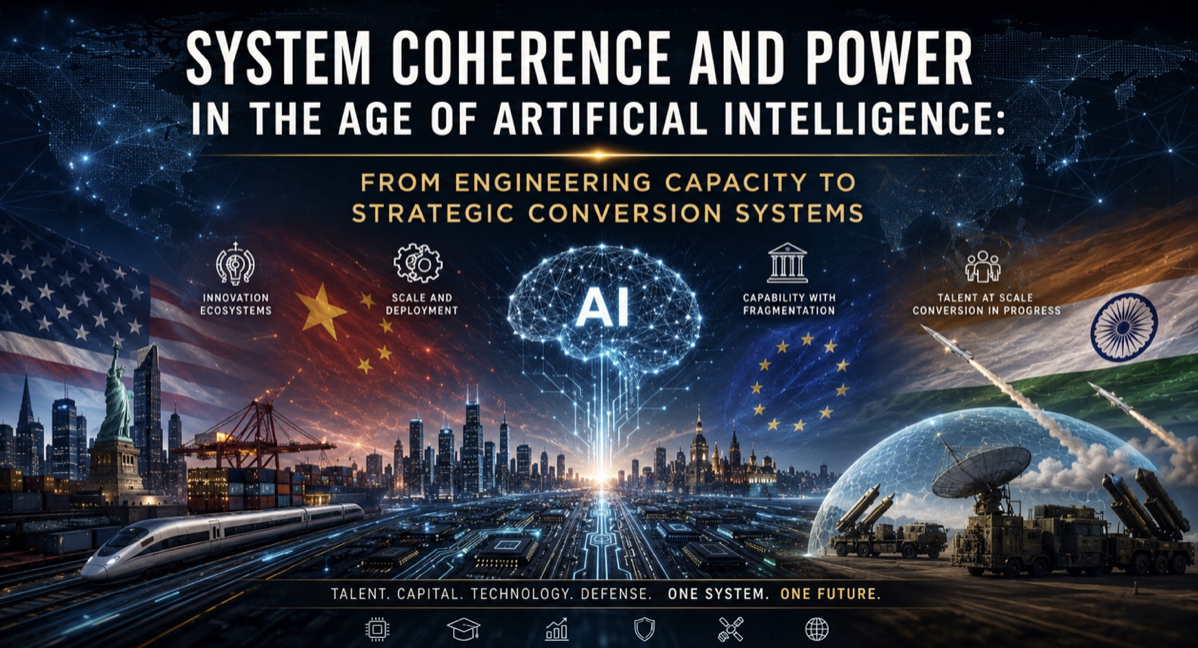

System Coherence and Power in the Age of Artificial Intelligence
Executive Summary
Global competition in artificial intelligence is often framed as a race in numbers—engineers, graduates, or research output. This framing is misleading.
The decisive variable is not how many engineers a system produces, but how effectively it converts technical human capital into scalable economic and technological power.
China produces approximately 1.3–1.5 million engineers annually, compared to 130,000–140,000 in the United States and 300,000–400,000 in Europe. India adds a further 800,000 to 1 million engineers per year, making it one of the largest talent pipelines globally. However, scale alone does not translate into power.
China faces estimated mismatch rates of 20–40%, the United States 10–20%, and Europe 15–30%. India exhibits even higher dispersion, with underemployment and skill mismatch often exceeding 40% outside top-tier institutions.
Artificial intelligence accelerates these dynamics. By automating 30–50% of mid-level engineering tasks, AI increases demand for highly specialized roles while compressing generalist positions.
At the system level, four distinct models emerge:
- The United States maximizes conversion efficiency through integrated innovation ecosystems.
- China maximizes scale and deployment capacity, while managing structural absorption constraints.
- Europe retains strong capabilities but in general lacks systemic integration and diffusion efficiency. Europe exhibits uneven systemic integration across member states, with significant differences between industrial, technological, regulatory, and defence integration capacities among core and peripheral economies.
- India represents large-scale talent production without fully developed systemic conversion capacity.
The strategic conclusion is clear:
Global competition in the age of AI is not about resources, but about system coherence—the ability to align talent, capital, and technology into a unified, adaptive structure.
Chapter 1 — The Engineer Gap Is Not About Numbers: Conversion Capacity in the Age of AI
Global competition over engineers is often simplified as a numerical race, but in reality it is an economic transformation problem: how effectively a system converts STEM human capital into innovation, productivity, and real economic value (OECD 2023; World Bank 2024).
China graduates approximately 1.3–1.5 million engineers per year, while the United States produces around 130,000–140,000 (China Ministry of Education 2024; National Science Board 2024). Europe produces 300,000–400,000 across fragmented systems, while India contributes an additional 800,000 to 1 million graduates annually, further increasing global supply (OECD 2023; World Bank 2024).
The key issue is not production, but absorption.
China exhibits mismatch levels of 20–40%. The United States maintains lower levels at 10–20%, supported by labor market flexibility (U.S. Bureau of Labor Statistics 2025). Europe sits between 15–30%, with strong regional divergence (OECD 2024). India shows higher dispersion, with mismatch often exceeding 40%, reflecting uneven quality and limited system-wide absorption capacity.
Artificial intelligence introduces a nonlinear shift. Up to 30–50% of mid-level engineering tasks may be automated (McKinsey Global Institute 2017; 2023), creating polarization between high-skill and routine roles (Autor and Dorn 2013).
The real gap is therefore systemic.
China combines scale with friction.
The United States combines efficiency with monetization.
Europe combines capability with fragmentation.
India combines scale with incomplete conversion.
The dominant variable becomes the share of engineers converted into high-productivity systemic capability, in other words what a system possesses.
It is fundamental, at this point, to underline that possessing technological capability does not automatically guarantee operational effectiveness. In AI-enabled systems, the decisive factor increasingly becomes execution under dynamic conditions: the ability to coordinate sensing, decision-making, adaptation, and response under conditions of time compression, uncertainty, and infrastructural stress.
This paper defines Systemic Conversion Capacity (SCC) as the ability of a state to convert distributed human, technological, and computational assets into coherent economic and strategic outcomes under conditions of structural constraint and operational uncertainty.
Chapter 2 — China’s Engineering Surplus and External Demand Dependence
China remains partially export-dependent, with exports at approximately 20–25% of GDP (World Bank 2024; IMF 2024).
When demand is strong, industrial expansion absorbs engineers. When it slows, mismatch rises (UNCTAD 2023).
China compensates through industrial upgrading and technological substitution (Rodrik 2018), and by expanding into emerging markets. However, these markets absorb volume more than high-margin value.
At the same time, structural constraints limit rapid rebalancing.
Global capital is gradually diversifying away from concentrated exposure to China, reflecting regulatory uncertainty and supply chain realignment. This reduces China’s centrality in global investment flows.
The real estate sector has transitioned from growth engine to constraint on capital reallocation efficiency, slowing the shift toward higher-productivity sectors.
Demographic aging increases fiscal pressure, while the absence of reserve currency status limits the ability to externalize adjustment costs.
The interaction of these factors creates a multi-constraint capital allocation environment, where growth, stability, and transformation must be managed simultaneously.
China’s challenge is not scale, but synchronized structural adjustment under constraint.
Chapter 3 — Stress Test: China Under a 15–20% Decline in Western Demand
A sustained decline in Western demand would reduce industrial expansion and engineering absorption.
Mismatch could rise toward 30–50%, increasing competition, compressing wages, and extending entry transitions (OECD 2024).
China retains mitigating tools: industrial upgrading, AI-driven transformation, and centralized coordination.
Two trajectories emerge.
An adaptive trajectory implies reabsorption and structural acceleration.
A friction trajectory implies persistent mismatch and declining efficiency.
The outcome depends on the speed of systemic adaptation relative to external demand contraction.
Chapter 4 — India: Scale Without Systemic Conversion
India represents a structurally distinct case in global competition.
It produces between 800,000 and 1 million engineers annually, placing it among the largest talent generators globally. However, this scale is not embedded in a fully integrated industrial or technological system.
Its economy performs strongly in IT services, outsourcing, and digital platforms, but lacks both China’s industrial depth and the United States’ integrated innovation ecosystem.
A significant share of engineering talent is absorbed through global service exports, multinational outsourcing, and migration toward advanced economies. As a result, underemployment and mismatch frequently exceed 40%, especially outside elite institutions.
Artificial intelligence introduces a dual dynamic.
It threatens parts of India’s service-based advantage by automating routine coding and standardized processes, while simultaneously creating opportunities in digital infrastructure, platform development, and AI-enabled services.
The critical constraint is conversion.
India lacks large-scale industrial coordination comparable to China and does not yet possess a fully developed innovation-finance ecosystem comparable to the United States.
It occupies an intermediate structural position: flexible, scalable, but not yet fully integrated.
The strategic question is whether India can transition from talent supplier to system-level technological power.
Chapter 5 — Geopolitics of AI and Markets
Global competition increasingly depends on control of technological architectures (Baldwin 2016).
Europe’s weakness lies not in capability, but in insufficient integration efficiency.
It possesses strong industry, research, and regulatory influence (European Commission 2023), but lacks coordinated execution capacity.
Artificial intelligence amplifies this limitation by reinforcing divergence in fragmented systems.
A further constraint is uneven skill distribution. Functional illiteracy and low digital proficiency limit large-scale adoption and diffusion of advanced technologies (OECD 2023).
As a result, Europe experiences internal bifurcation between competitive core economies and more dependent peripheral systems.
Europe does not lack capability—it lacks the level of strategic synchronization required to convert capability into power in the age of AI.
The United States dominates through platforms, standards, and ecosystem integration (Stanford HAI 2025), capturing value in high-margin segments.
China expands through infrastructure, manufacturing, and emerging markets (UNCTAD 2023), prioritizing scale and deployment.
India develops as a flexible but not yet fully integrated system, positioned between global talent supplier and potential future technological pole.
Public discourse often simplifies these dynamics, focusing on numerical gaps or assumed resilience. Such narratives obscure structural constraints and contribute to policy misalignment.
Integrated 10-Year Scenario
The United States consolidates leadership through ecosystem control and innovation.
China expands through scale and internal adaptation, constrained by absorption dynamics.
Europe risks bifurcation between integrated industrial cores and dependent peripheries.
India evolves along a critical path: either converging toward system-level integration or remaining structurally externalized as a talent provider.
Figure 1 — Structural Asymmetries in Global Systemic Conversion Capacity (2025).
Comparative indicators of engineering scale, AI compute concentration, semiconductor dependence, defense-technological expenditure, cloud-platform dominance, and satellite/ISR infrastructure across major global actors. Values are indicative ranges derived from public institutional datasets and are intended to illustrate structural differences in Systemic Conversion Capacity (SCC) rather than precise national rankings. Sources include OECD (2024), Stanford HAI (2025), World Bank (2024), SIPRI (2024), IMF (2024), NSB (2024), McKinsey Global Institute (2023), UNCTAD (2023), and public defense-industrial datasets.
Transition — From Economic Conversion to Strategic Stress Testing
The analytical framework developed so far has treated conversion capacity primarily as an economic and industrial variable: the ability of national systems to transform technical human capital into productivity, innovation, and scalable technological output.
However, once artificial intelligence becomes embedded in national security architectures, conversion capacity ceases to be purely economic and becomes systemic across domains, extending into defense, deterrence, and real-time strategic response.
Operationalizing Systemic Conversion Capacity (SCC)
To operationalize the analytical framework developed throughout this study, Systemic Conversion Capacity (SCC) can be understood as the interaction between multiple interdependent layers of national power rather than as a single economic or technological indicator.
In practical terms, SCC reflects the ability of a system to synchronize:
•human capital,
•technological infrastructure,
•computational capability,
•industrial coordination,
•institutional adaptability,
•and strategic decision-making
under conditions of uncertainty, stress, and real-time constraint.
This implies that systemic power in the age of artificial intelligence no longer derives exclusively from resource accumulation or technological ownership, but increasingly from the coherence of interaction between critical national subsystems.
Within this framework, economic productivity, innovation ecosystems, AI deployment, and military resilience become interconnected expressions of the same underlying systemic property: conversion capacity under dynamic conditions
This introduces a critical implication: if economic systems can be evaluated by their efficiency in converting engineers into productivity, then strategic systems can be evaluated by their ability to convert computational intelligence into survivable national defense capability under extreme conditions.
Of course the following scenario should be interpreted as a technologically plausible strategic stress–test model rather than as a confirmed operational capability assessment.
Within this context, military AI integration—particularly in missile defense against hypersonic systems and autonomous swarm threats—emerges not as a separate domain, but as a stress test of systemic coherence itself.
The reason is structural: unlike economic systems, which can absorb inefficiencies over time, defense systems operate under instantaneous failure thresholds. This makes them a stringent test of whether a state possesses true system integration capacity or only partial technological capability.
For this reason, the emergence of AI-enabled multi-layer defense architectures—such as those hypothetically being developed in India—should be interpreted not as an isolated military development, but as a system-level stress test of the global order under conditions of technological acceleration.
This provides the conceptual entry point for the following chapter
Emerging Systemic Stress Factor: AI Militarization of Strategic Defense
A potential structural stress factor for the global system is the rapid convergence between artificial intelligence and advanced missile defense architectures, particularly those designed to counter hypersonic and swarm-based attack systems.
Unlike traditional military capabilities, these systems operate under extreme time compression, where decision latency, sensor fusion accuracy, and computational coordination determine systemic survival.
This creates a new category of stress test:
•not economic absorption capacity
•not industrial scalability
•but real-time systemic survivability under AI-mediated conflict conditions
If emerging actors such as India succeed in developing such architectures, the global system may experience a non-linear reordering of strategic hierarchies, as defensive AI capability becomes a standalone source of geopolitical power.
This reinforces the central thesis of this work: system coherence is not only an economic variable, but a cross-domain constraint spanning production, innovation, and security
Chapter 6 — AI-Driven Missile Defense and the Emergence of Systemic Military Power: The India Case
In the evolving structure of global competition, military capability is increasingly defined not by isolated weapon systems, but by the ability to integrate artificial intelligence, distributed sensing, and real-time interception architectures. This represents a shift from platform-centric deterrence to system-centric defense capacity, where strategic advantage emerges from coordination speed, data fusion, and predictive decision-making rather than from single kinetic assets.
Within this framework, a hypothetical but technologically plausible development becomes strategically significant: the emergence of an Indian missile defense system highly effective against both drone swarms and hypersonic missiles. Such a capability would not constitute a marginal upgrade in defensive technology, but a structural transformation in regional and potentially global security dynamics.
Hypersonic glide vehicles can maneuver at speeds exceeding Mach 5 while altering trajectory during flight, drastically reducing predictability compared to traditional ballistic systems and complicating interception calculations in real time. Similarly, drone swarms introduce saturation dynamics in which large numbers of low-cost autonomous systems can overwhelm conventional air-defense architectures by forcing simultaneous tracking and interception across multiple vectors
A system capable of addressing both threats simultaneously would require a deeply integrated architecture combining space-based sensors, ground and airborne radar networks, AI-driven trajectory prediction, and layered interception mechanisms operating at extremely low latency.
In operational terms, interception windows against hypersonic systems may compress decision cycles to seconds or sub-second intervals, reducing the margin for human-mediated response and increasing dependence on AI-assisted target classification and predictive coordination.
The effectiveness of such architectures depends heavily on sensor fusion capacity: the ability to integrate heterogeneous real-time data streams from satellites, radar systems, airborne assets, and autonomous platforms into coherent operational awareness under conditions of uncertainty and electronic disruption
Obviously while facing these facts and circumstances we have to keep in consideration that AI represents only one face of the medal because AI–enabled defence architectures don’t eliminate uncertainty. They shift strategic competition toward resilience under degraded conditions, contested sensing environments, latency disruption, and adversarial manipulation.
This in order to not to forget that, from a technical point of view, speed and AI integration represent only a part of the problem in consideration of the fact that all this has to acknowledge sensor uncertainty, degraded communications, contested infrastructure, adversarial deception, model reliability under conflict conditions, latency failure and cascading coordination breackdown.
This implies that the relevant innovation is not merely in hardware, but in system orchestration capacity—a concept closely aligned with the broader analytical framework of conversion capacity developed in this study. Just as economic systems are evaluated by their ability to convert STEM human capital into high-productivity output, military systems are increasingly evaluated by their ability to convert data, sensors, and computational power into real-time defensive effectiveness.
If India were to achieve such a capability, the implications would extend across three interconnected dimensions.
First, at the regional strategic level, India’s deterrence posture would shift significantly. Against China, it would reduce the effectiveness of limited coercive or grey-zone escalation strategies by increasing the probability of interception failure. Against Pakistan, it would further alter the conventional military balance by weakening the credibility of rapid-strike doctrines. The net effect would be a transition from deterrence based primarily on offensive capability to deterrence increasingly grounded in defensive resilience and system robustness.
Second, at the technological-industrial level, such a system would require a deep and sustained expansion of India’s high-end engineering ecosystem. This would increase domestic demand for advanced expertise in AI systems, aerospace engineering, sensor fusion, and distributed computing architectures. In this sense, the defense sector would act as a catalytic mechanism for accelerating India’s transition from a large-scale producer of engineering talent to a system-integrated technological power. This directly connects to the broader global pattern identified earlier: the decisive factor is not the quantity of engineers, but the system’s ability to convert them into operational capability.
Third, at the global systemic level, the emergence of an effective anti-hypersonic and anti-swarm defense architecture would accelerate a broader transformation in military doctrine. The United States, China, and other advanced actors would be forced to respond by further integrating artificial intelligence into multi-domain defense systems, expanding space-based sensor networks, and developing more adaptive offensive trajectories. The result would be an intensification of the global AI-military feedback loop, in which offensive and defensive systems co-evolve at increasing speed.
Russia occupies a structurally distinct position within this emerging landscape. Unlike the United States and China, its strategic relevance derives less from broad economic conversion capacity and more from concentrated military-technological capabilities, particularly in missile systems, strategic deterrence, and hypersonic weapons development.
Following the end of the Cold War, Russia explored forms of strategic integration with the Western security architecture, including phases of political rapprochement with NATO structures. However, the absence of durable integration mechanisms, combined with progressive geopolitical divergence, contributed to the emergence of an increasingly adversarial relationship between Russia and the Western bloc.
Over time, this dynamic accelerated Russia’s economic and strategic reorientation toward China. Under conditions of sanctions pressure, restricted financial access, and technological containment, Moscow became increasingly dependent on Beijing for energy export absorption, economic stabilization, financial resilience, and selective technological cooperation.
This reduces Russia’s autonomous systemic leverage. While the Russian Federation retains substantial military capabilities and strategic depth, its ability to operate as an independent pole of global power is increasingly constrained by structural dependence on China’s industrial and economic ecosystem.
In systemic terms, Russia represents a model of asymmetric strategic concentration: high military intensity without equivalent economic conversion depth.
In this scenario, the United States would likely reinforce its advantage in system integration and technological ecosystem dominance, leveraging its leadership in AI platforms and defense-industrial coordination. China would respond by accelerating its capacity for large-scale deployment and saturation-based strategies, maintaining strength in industrial throughput and system replication. Europe would remain structurally constrained by fragmentation, retaining pockets of excellence but limited systemic integration capacity. India, if successful in this trajectory, would emerge as a new category of actor: a selective high-end system integrator capable of transforming scale into strategic resilience.
Ultimately, the significance of such a development is not limited to military balance. It reinforces the central thesis of this work: in the age of artificial intelligence, power is defined less by isolated capabilities and more by the coherence of systems that integrate talent, computation, infrastructure, and decision-making speed into unified operational architectures.
Military defense, like economic productivity, is therefore entering the same structural logic: the competition is no longer about individual assets, but about systemic conversion capacity under real-world constraints.
Meta-Conclusion
Global competition in the age of artificial intelligence is defined by integration efficiency under multi-domain stress.
Economic systems, labor markets, and defense architectures are converging toward a single structural logic: the ability to convert distributed human capital, data flows, and technological infrastructure into synchronized, adaptive systems.
The United States maximizes integration and conversion efficiency across civil and military domains.
- China maximizes scale, deployment capacity, and industrial throughput under structural constraints.
- Europe retains high-level capabilities but remains limited by fragmentation and incomplete systemic integration.
- Russia maintains significant strategic and military capabilities, but with increasingly constrained autonomous conversion capacity due to structural economic dependence on China.
- India represents a high-volatility system: massive talent supply with emerging but uneven conversion capacity
The introduction of AI-driven military systems transforms defense from a separate domain into a stress test of systemic power itself, where technological superiority depends on real-time coordination rather than static capability.
Artificial intelligence does not simply redistribute economic power; it amplifies structural asymmetries between coherent and fragmented systems, accelerating divergence across both economic and strategic domains.
The next phase of global competition will therefore be determined not by resource accumulation, but by systemic conversion under conditions of uncertainty, saturation, and real-time pressure across both economic and military architectures.
AI does not reward technology alone.
It rewards coherent systems capable of conversion under stress
Bibliography
Acemoglu, Daron, and Pascual Restrepo. 2020. “Robots and Jobs: Evidence from US Labor Markets.” Journal of Political Economy 128 (6): 2188–2244.
Autor, David H. 2015. “Why Are There Still So Many Jobs? The History and Future of Workplace Automation.” Journal of Economic Perspectives 29 (3): 3–30.
Autor, David H., and David Dorn. 2013. “The Growth of Low-Skill Service Jobs and the Polarization of the US Labor Market.” American Economic Review 103 (5): 1553–1597.
Baldwin, Richard. 2016. The Great Convergence: Information Technology and the New Globalization. Cambridge, MA: Harvard University Press.
Brynjolfsson, Erik, and Andrew McAfee. 2014. The Second Machine Age: Work, Progress, and Prosperity in a Time of Brilliant Technologies. New York: W.W. Norton & Company.
Center for Strategic and International Studies (CSIS). 2024. AI and Future Defense Systems. Washington, DC: CSIS.
China Ministry of Education. 2024. Statistical Bulletin on National Education Development. Beijing: Ministry of Education.
European Commission. 2023. European Innovation Scoreboard 2023. Brussels: European Commission.
Eurostat. 2024. Science, Technology and Digital Economy Statistics. Luxembourg: European Commission.
International Institute for Strategic Studies (IISS). 2024. The Military Balance 2024. London: Routledge.
International Monetary Fund (IMF). 2024. World Economic Outlook Database. Washington, DC: IMF.
McKinsey Global Institute. 2017. A Future That Works: Automation, Employment, and Productivity. New York: McKinsey & Company.
McKinsey Global Institute. 2023. Generative AI and the Future of Work. New York: McKinsey & Company.
NASSCOM. 2024. Strategic Review of the Indian IT Industry. New Delhi: NASSCOM.
National Science Board. 2024. Science and Engineering Indicators 2024. Alexandria, VA: National Science Foundation.
OECD. 2023. Education at a Glance 2023: OECD Indicators. Paris: OECD Publishing.
OECD. 2024. OECD Employment Outlook 2024. Paris: OECD Publishing.
Reserve Bank of India. 2024. Annual Report 2024. Mumbai: Reserve Bank of India.
Reserve Bank of India. 2024. Digital Economy and Productivity Report. Mumbai: RBI.
Rodrik, Dani. 2018. “New Technologies, Global Value Chains, and the Developing Economies.” NBER Working Paper No. 25164.
Semiconductor Industry Association (SIA). 2024. 2024 State of the U.S. Semiconductor Industry. Washington, DC: SIA.
Russian Federation Ministry of Digital Development. 2024. Digital Economy Indicators Report. Moscow: Government of the Russian Federation.
Russian Federation Federal State Statistics Service (Rosstat). 2024. Education and Labor Market Statistics. Moscow: Rosstat.
Stanford University Human-Centered AI Institute. 2025. AI Index Report 2025. Stanford, CA: Stanford University.
Stockholm International Peace Research Institute (SIPRI). 2024. SIPRI Military Expenditure Database. Stockholm: SIPRI.
United Nations Conference on Trade and Development (UNCTAD). 2023. Trade and Development Report 2023. Geneva: United Nations.
U.S. Bureau of Labor Statistics. 2025. Occupational Outlook Handbook: Engineers and STEM Occupations. Washington, DC: U.S. Department of Labor.
U.S. Department of Defense. 2024. Defense Budget Overview. Washington, DC: U.S. Department of Defense.
World Bank. 2024. World Development Indicators. Washington, DC: World Bank.
World Economic Forum. 2024. Future of Jobs Report 2024. Geneva: World Economic Forum.


