


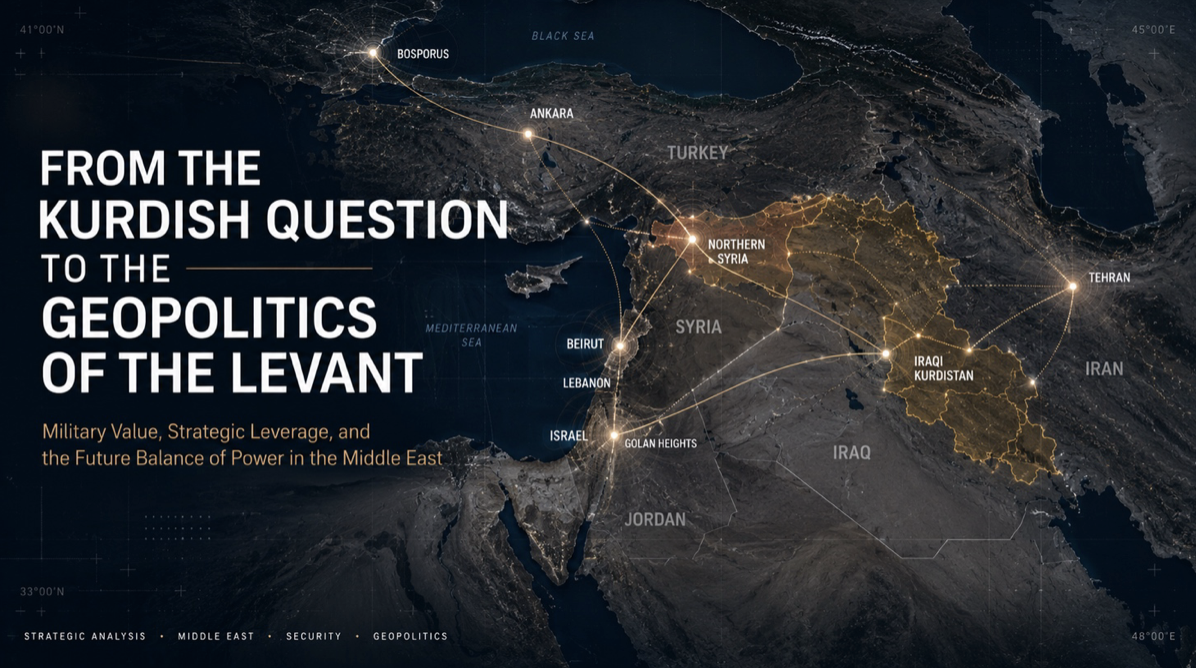

From the Kurdish Question to the Geopolitics of the Levant
Introduction – From a recent article by Hadi Elis on the geopolitical question of the 21st century.
The article by Hadi Elis, former spokesperson for the Canadian Kurdish Federation for 14 years, titled “NATO, Türkiye, and the Kurdish Question: Why the Alliance Still Sides with Ankara,” which appeared on July 29, 2026, in Diplomatic Insider, raises a question that goes far beyond the Kurdish issue alone.
Why might an ally that has demonstrated indisputable military effectiveness on the ground be progressively marginalized when the strategic context changes?
The most immediate answer would seem to concern exclusively the relationship between NATO, Türkiye, and the Kurdish people.
In reality, the problem is far more general. In the history of international relations, great powers rarely build their alliances on the basis of gratitude or loyalty. They build, modify, and sometimes abandon them according to the hierarchy of their strategic interests.
As the realist tradition in international relations teaches, states tend to preserve the balance of power rather than reward the loyalty of their partners. Alliances are not moral pacts, but functional tools for safeguarding the national interest.
The Kurdish issue is perhaps the most emblematic example of this dynamic.
From the failure to implement the Treaty of Sèvres to the fight against the Islamic State, through the crises of 1975, 1991, and 2019, the Kurds have repeatedly experienced a constant pattern: they are considered indispensable partners during periods of conflict but rarely permanent stakeholders in defining the new regional order.
The aim of this essay is not to determine whether Kurdish claims are right or wrong.
Rather, it is to explore a broader question: “How can an actor prove itself essential on the military front without managing to translate that value into stable political influence?”
From this question arises a second, even more pertinent one:
“If the project of a territorial Kurdistan seems difficult to achieve today, is it possible that the Kurds’ true political capital lies not so much in controlling a state as in their ability to become an indispensable strategic lever for the balance of power in the Middle East?”
This is the hypothesis that this essay aims to explore.
The Kurdish Paradox
The Kurdish issue is one of the most complex unresolved geopolitical problems in the contemporary Middle East.
A people numbering tens of millions, spread primarily across Turkey, Syria, Iraq, and Iran, has repeatedly seen the possibility of establishing its own autonomous political entity slip away due to territorial fragmentation, the interests of regional states, and the shifting allegiances of the great powers.
The fundamental paradox is clear: the Kurds have proven to be one of the most effective military actors in the fight against jihadism, but this strategic utility has not automatically translated into lasting political recognition.
The central question, then, becomes: why does such a valuable actor remain so vulnerable?
The answer lies in the difference between being necessary at a particular historical juncture and becoming indispensable to the overall balance of power in a region.
The Lesson of ISIS: Military Strength Without Political Support
The war against the Islamic State marked the peak of international recognition of Kurdish capabilities.
Syrian Kurdish forces, integrated into the Syrian Democratic Forces (SDF), served as the primary ground partner of the U.S.-led international coalition in the campaign against the caliphate.
The defense of Kobane, their participation in the operations that led to the fall of Raqqa, and their subsequent control of vast areas of northeastern Syria demonstrated their organizational skills, discipline, and reliability.
For many Western observers, the Kurdish forces represented a rare example in the region: a local actor capable of effectively combating a jihadist threat without pursuing an agenda of regional destabilization.
However, once the ISIS threat was reduced, the priorities of external powers shifted.
Turkey has continued to view Syrian Kurdish forces linked to the Kurdistan Workers’ Party (PKK) as a threat to its national security, while Washington has sought to maintain a delicate balance between cooperation with the Kurds and the need to preserve its relationship with Ankara.
This has given rise to deep Kurdish frustration: the feeling of having been allies when they were needed, but not sufficiently protected once the balance of power shifted.
The issue is not just about the past. It concerns the future.
A player who depends solely on the utility of the moment risks being abandoned when the strategic context changes.
Abandonment Syndrome: When the Alliance Fails to Provide Security
The contemporary history of the Kurds is marked by a recurring pattern: support from the great powers tends to be strong when it aligns with a strategic interest, but rarely turns into a permanent guarantee.
This experience has given rise to a genuine geopolitical memory of abandonment.
1975: The End of Support for the Iraqi Kurdish Uprising
An early example dates back to 1975.
The Kurdish uprising in Iraq led by Mustafa Barzani had received external support, partly due to regional rivalry against Saddam Hussein’s regime. However, the Algiers Agreement between Iran and Iraq shifted the balance of power.
Tehran ceased its support for the Iraqi Kurds, and the United States chose not to intervene directly. For many Kurds, this demonstrated that the interests of the great powers could quickly override previous commitments.
1991: Humanitarian Protection Without a Political Solution
After the 1991 Gulf War, the international community intervened to prevent a humanitarian catastrophe affecting the Iraqi Kurds. The creation of a protected zone allowed for a certain degree of de facto autonomy.
However, this phase, too, did not lead to the establishment of an independent state. Once again, temporary protection did not translate into definitive political recognition.
2019: The Syrian Crisis
The most recent case is that of Syria.
After years of military cooperation in the fight against the Islamic State, the reduction of the U.S. presence in northeastern Syria was perceived by many Kurds as a strategic abandonment.
The subsequent Turkish offensive against Syrian Kurdish forces reinforced the belief that Washington was willing to prioritize its relationship with Ankara over the protection of a partner that had fought alongside it.
These events have led to a deep-seated conviction: the Kurds may be indispensable for winning a war, but expendable in the construction of the subsequent political order.
The challenge, therefore, is no longer merely to prove one’s worth. It is to transform that value into a permanent negotiating position.
From the Promise of Sèvres to the Reality of Lausanne: The Birth of the Modern Kurdish Question
To understand the depth of the Kurdish issue, we must go back to the period following World War I, when the collapse of the Ottoman Empire ushered in a phase of redefining the balance of power in the Middle East. The 1920 Treaty of Sèvres marked, at least formally, the moment when the creation of an autonomous Kurdish entity seemed possible.
The treaty, in fact, provided for a path toward Kurdish autonomy in eastern Anatolia and left open the prospect of future independence. That prospect, however, never materialized.
The victory of the Turkish nationalist movement led by Mustafa Kemal radically altered the political landscape. The subsequent Treaty of Lausanne of 1923, which replaced the Treaty of Sèvres, no longer contained any reference to a Kurdish state and enshrined the establishment of the modern Turkish Republic within its recognized borders.
From that moment on, the Kurdish question entered a long phase of international marginalization.
The international community chose the stability of existing states over the principle of Kurdish self-determination.
This historical rift still underlies the Kurdish perception of an unresolved injustice today: the conviction that an international promise was sacrificed on the altar of geopolitical balances.
PART II
From Historical Kurdistan to Strategic Significance: The Transformation of the Kurdish Question
The following analysis is not intended to propose a specific territorial solution or to advocate for unilateral changes to internationally recognized borders. The objective is to examine, in theoretical terms, how an actor’s strategic role can influence its political clout, regardless of the feasibility of the various territorial scenarios.
The Boundaries of Historic Kurdistan
The project for an independent Kurdistan based on historical territorial continuity faces nearly insurmountable obstacles today.
The difficulty stems not only from opposition by the states where Kurdish communities are present, but also from the internal complexity of the Kurdish world itself.
The historic Kurdish territory is, in fact, divided primarily among four states:
- Turkey;
- Iran;
- Iraq;
- Syria.
Each of these countries views any prospect of Kurdish independence as a potential threat to its territorial integrity.
For Ankara, the Kurdish issue is linked above all to the fear that an autonomous Kurdish entity in Syria or Iraq could strengthen the domestic Kurdish movement.
For Tehran, the issue is part of the broader problem of managing national minorities and controlling its peripheral regions.
For Damascus, any form of territorial autonomy represents a challenge to the traditional centralist conception of the Syrian state.
Even in Iraqi Kurdistan, where the most advanced form of political autonomy exists, the transition toward full independence has proven extremely difficult.
The 2017 independence referendum clearly demonstrated the limitations of a strategy based exclusively on national claims: without international consensus and without a convergence of interests among the major powers, even strong domestic popular support may not be sufficient.
In this context, a different line of thought emerges: if a “historical Kurdistan” is difficult to achieve in the classic form of a nation-state, could there be another form of recognition based not on territorial continuity but on strategic function?
This is where the concept of geopolitical leverage arises.
From Territorial Identity to Strategic Function
Throughout international history, many actors have gained influence not only because of their territorial or demographic size, but because they have become indispensable to the balance of power among the major powers. The ability to influence events does not always stem from size.
Sometimes it stems from location. Sometimes from military capability. Sometimes it stems from the fact that excluding a country would incur a higher cost than keeping it in the fold.
This is the case for several small or medium-sized actors that have transformed their strategic location into an element of national security.
The question, therefore, would not be merely “Where should a Kurdistan be established?”, but rather “Where and how can the Kurds become a factor that no regional actor can ignore?”
This perspective radically changes the problem.
The Kurdish question would no longer be merely a territorial claim, but a quest for a permanent strategic position.
The key shift would be:
• from a people useful in emergencies
• to a necessary player in the regional balance of power.
From this perspective, a Kurdish presence in areas of particular geopolitical significance might represent not necessarily the fulfillment of the Kurdish national dream, but a negotiating platform capable of altering the regional balance of power.
The value of a political actor derives not only from what it possesses, but also from what others would lose if it were marginalized.
If the Kurdish question is no longer viewed from the perspective of self-determination but rather from that of regional balance, it becomes inevitable to question the interests of the other Middle Eastern powers. Among these, Israel occupies a particularly significant position, as its perception of regional security is closely linked to containing Iranian influence and maintaining the balance of power in the Levant.
Israel and the Iranian Factor
One of the factors that complicates the situation in the Middle East is the convergence—at least partial—of interests between Israel and certain Kurdish forces.
Of course, a convergence of interests does not automatically equate to a formal alliance. Israel, like any state, acts according to a realist logic grounded in national security.
However, there are common elements in their strategic assessments. The main one concerns the expansion of Iranian influence in the region.
From Israel’s perspective, the Islamic Republic poses not only a threat related to its nuclear program or missile capabilities, but above all a regional system of power projection.
This system includes:
- support for Hezbollah in Lebanon;
- the strengthening of allied militias in Iraq and Syria;
- the creation of strategic depth that allows Tehran to exert pressure far beyond its own borders
Syria is the central hub of this architecture.
Control of the land routes connecting Iran, Iraq, Syria, and Lebanon is of fundamental importance because it enables the transfer of personnel, supplies, and technology to Hezbollah.
For Israel, therefore, the problem is not only military but also geographical: whoever controls the intermediate spaces of the Levant gains the ability to exert regional pressure.
From this perspective, a strong Kurdish partner could prove valuable not as a substitute for existing states, but as a balancing force. A stable local actor, not controlled by Tehran and not subordinate to Ankara, could represent a strategic variable in an extremely competitive system. However, here too, we must avoid oversimplifications. Israel is unlikely to make unlimited commitments to new political actors.
Its strategic tradition prioritizes deterrence, the maintenance of military superiority, and the building of relationships that serve national interests. A potential relationship with the Kurds would therefore likely be based more on a convergence of interests than on an absolute guarantee.
The Levant as a Battleground: Iran, Syria, and Hezbollah
The strategic importance of the Levant stems from its geographic location. This region serves as the crossroads between the eastern Mediterranean, Mesopotamia, and the inner Middle East.
Whoever influences the Levant possesses a capacity for projection that far exceeds local territorial boundaries. For Iran, Syria is a fundamental element of its strategic depth.
Over the years, Tehran has built a network of political and military ties with Hezbollah in Lebanon through Syrian territory. This network allows Iran to maintain a forward presence near Israeli territory and to exert pressure without direct confrontation.
Iran’s logic is that of strategic depth: shifting the confrontation away from its own borders and building a belt of regional allies and partners. From Israel’s perspective, this configuration represents one of the main threats.
The concern is not only the quantity of weapons available to Hezbollah, but the possibility that a coordinated regional network capable of maintaining constant pressure could take root. In this context, southern Syria and the areas near the Golan Heights take on particular importance.
The stability of southern Syria, control over transportation routes, and the presence of forces aligned with Iran are central elements of Israel’s strategic calculus. It is precisely within this complex landscape that the potential value of a Kurdish actor emerges. Not as a force destined to replace existing states. Not as a tool for a new regional partition. But as an additional balancing element in a system in which every actor seeks to prevent its rivals from gaining a decisive advantage.
The Kurdish question thus becomes part of a broader dynamic: not merely national self-determination, but competition for control over the balance of power in the Levant.
Russia and the Kurdish Question: A Bargaining Chip Rather Than a Political Project
While the United States represents the most obvious example of an ambiguous relationship with the Kurds, Russian policy also offers a significant example of how great powers tend to view the Kurdish issue primarily as a tool for strategic balance.
Since the Soviet era, Moscow has viewed the Kurdish world with interest, but rarely with the aim of fostering the creation of an independent state. At certain times, the Soviet Union supported Kurdish movements or encouraged their aspirations, but always within the context of a broader geopolitical competition with Turkey—a NATO member—and other regional actors.
Even after the end of the Cold War, this approach has remained essentially unchanged.
For the Russian Federation, the Kurdish issue is not so much an autonomous political project as a useful variable in managing relations with Ankara, Damascus, Tehran, and, indirectly, with the United States.
The Syrian civil war has illustrated this approach with particular clarity.
The primary objective of Russia’s 2015 military intervention was to ensure the survival of Bashar al-Assad’s government and to maintain Russian influence in the eastern Mediterranean through the bases at Tartus and Hmeimim.
Within this framework, relations with the Syrian Kurdish forces have been characterized by constant flexibility.
At certain stages, Moscow facilitated dialogue between the Syrian Democratic Forces (SDF) and the Damascus government, acting as a mediator. At other times, it kept political channels open with Kurdish authorities, suggesting that some form of autonomy could be discussed as part of a future reorganization of the Syrian state.
However, this openness has never translated into explicit support for Kurdish independence.
For Moscow, in fact, excessive fragmentation of Syria would have risked weakening the very government that Russia had intervened to save.
At the same time, the Kremlin has had to manage its relationship with Turkey.
Despite the deep differences that emerged in Syria, Libya, and the South Caucasus, Moscow and Ankara have built a pragmatic relationship in recent years, based on energy cooperation, economic exchanges, and ongoing negotiations over their respective spheres of influence.
In this context, openly supporting a Kurdish independence movement would have meant jeopardizing a dialogue that Russia considers strategically useful. The result is a policy of balancing acts.
Moscow maintains contacts with the Kurds but avoids making them an exclusive ally.
It engages in dialogue with Ankara, but without ruling out the possibility of using the Kurdish issue as a bargaining chip.
It supports Damascus, but periodically encourages forms of dialogue between the Syrian government and Kurdish authorities when this can strengthen its own diplomatic position.
Russian policy thus confirms a pattern already observed in the behavior of the United States.
The major powers do not tend to support the Kurdish cause as such. Rather, they tend to use the Kurdish issue as a tool through which to exert influence over other regional actors.
For the Kurds, this represents a particularly important lesson.
While Washington has often viewed them as an operational partner and Moscow as a bargaining chip, both powers have subordinated their relationship with the Kurdish world to broader strategic interests.
A significant conclusion follows: the Kurds’ political vulnerability depends not only on opposition from the states in which they live, but also on the fact that none of the great powers has so far deemed it expedient to invest definitively in building their full international political agency.
Paradoxically, it is precisely this convergence of behavior between the United States and Russia that reinforces the hypothesis developed in this essay.
The fundamental issue is not to identify which great power might “grant” a Kurdistan, but rather to understand how the Kurds can acquire a strategic role such that their permanent involvement in the regional balance of power becomes advantageous for all the major actors. In other words, the real challenge lies not in securing patronage, but in transforming their tactical relevance into a structural geopolitical asset.
PART III
The American Dilemma: Ankara or the Kurds?
The greatest strategic contradiction in the Kurdish issue concerns the United States.
Washington faces a problem that is difficult to resolve: Turkey and the Kurds represent two different forms of strategic value, but they are not always compatible.
Turkey is an ally of enormous importance to NATO. Its geographical position is unique: it controls the Bosporus and Dardanelles Straits, connects Europe and the Middle East, possesses one of the Alliance’s largest armed forces, and is an essential element in the security of the Black Sea and NATO’s southeastern flank.
For Washington, losing Ankara entirely would create a strategic vacuum that could be exploited by Russia, Iran, or China. However, the Turkey of recent years is no longer simply the ally that Washington envisioned during the Cold War.
Ankara has developed an increasingly autonomous foreign policy, based on carving out its own space between the West, Russia, and the Middle East.
The question that arises, therefore, is: “To what extent can an ally pursue an independent policy before becoming a source of strategic uncertainty?”
Turkey Between NATO, Russia, and the Middle East
The relationship between Ankara and Moscow perfectly illustrates this ambiguity. Turkey and Russia are rivals in various regional theaters.
In Syria, they have often backed opposing sides: Ankara supported forces hostile to Bashar al-Assad’s regime at certain stages of the conflict, while Moscow intervened militarily in support of Damascus.
In Libya, Turkey has backed the Tripoli-based Government of National Accord, while Russia has supported the eastern front led by General Khalifa Haftar through assistance to its military apparatus and, in the past, through the presence of Russian contractors.
Yet, despite these differences, Ankara and Moscow have maintained channels of cooperation. Energy, trade, diplomacy, and regional security have forged a relationship in which competition and collaboration coexist.
This characteristic is fundamental to understanding contemporary Turkish politics. Ankara does not necessarily seek a stable alignment with a single power. It pursues autonomy.
Its relationship with Russia and Iran does not necessarily mean turning its back on the West, just as remaining in NATO does not automatically mean full adherence to American priorities. Turkey seeks to maximize its room for maneuver.
And it is precisely this ability to navigate between multiple poles that makes Ankara both valuable and problematic for Washington.
The Libyan Case: A Demonstration of Turkey’s Strategy
Libya is one of the clearest examples of Turkey’s new foreign policy.
Turkey’s military intervention in the Libyan conflict prevented the fall of the Tripoli government and allowed Ankara to consolidate its presence in the eastern Mediterranean.
However, the competition with Haftar and the actors supporting him revealed a broader dynamic: Turkey was not merely defending local interests but was seeking to build strategic depth in the Mediterranean.
In fact, Turkey’s presence in Libya had multiple dimensions:
- military;
- energy;
- maritime;
- diplomatic.
This was linked to Turkey’s broader policy in the eastern Mediterranean, where Ankara has sought to assert its claims to maritime economic zones and energy resources.
The result is a Turkey that does not behave merely as a regional ally of the United States, but as a middle power with ambitions of its own.
The F-35 Issue and the Western Contradiction
The issue of arms makes the complexity of the relationship between Washington and Ankara even more evident.
Turkey was initially part of the F-35 program but was excluded after purchasing the Russian S-400 missile system.
The U.S. decision stemmed from technical and strategic concerns: the presence of an advanced Russian system within the military architecture of a NATO country was considered a risk to the Alliance’s security.
However, the ensuing debate highlighted a broader issue: to what extent is it appropriate to provide military support to a country that simultaneously maintains relations with Moscow, pursues an independent regional policy, and often takes a critical stance toward Israel?
The U.S. response is generally based on a realist logic: it is preferable to keep Turkey anchored to the Western system rather than push it definitively toward other poles.
But this choice creates a problematic perception among other regional partners.
For many Kurds, the message is clear: their military reliability is not enough to guarantee lasting political support.
For Israel, on the other hand, another question arises: How predictable can an increasingly autonomous Turkey be?
The real dilemma: balance or dependence?
The U.S. strategic problem is not simply a choice between Ankara and the Kurds. The reality is more complex.
Turkey offers the United States what few other countries can: geographical location, military infrastructure, diplomatic clout, and conventional capabilities.
The Kurds, on the other hand, offer a different kind of value: reliability on the ground, local knowledge, and the ability to operate in environments where Western armies are reluctant to engage directly.
These are two different tools. The risk for Washington, however, is that of creating excessive dependence on a single regional actor.
History shows that the balance of power can shift rapidly. An ally considered indispensable today may become a problem tomorrow.
For this reason, the Kurdish issue could take on a different significance: not as a replacement for Turkey, but as a balancing factor.
A more balanced regional policy might require not abandoning Ankara, but building a broader network of reliable partners.
Conclusion: Kurdistan in the 21st Century—A State or a Strategic Role?
The Kurdish issue may not be resolved through the creation of a traditional nation-state.
The territorial, political, and diplomatic obstacles are, in fact, enormous, to say the least.
But this does not mean that the Kurds’ political influence is destined to remain marginal; consequently, the real challenge may lie in transforming the military capital accumulated over the past decades into diplomatic capital.
It is no coincidence that international history teaches us that smaller actors gain security when their survival becomes a matter of interest to larger actors, and it is precisely in this sense that the Kurdish future may depend not only on the conquest of a historic territory, but on the ability to become a structural element of the Middle Eastern balance of power.
The true Kurdistan of the 21st century may not necessarily be a line on a map, but rather take the form of a strategic function, a role, a capacity for influence—an element whose exclusion would come at too high a cost for anyone seeking to shape the future of the Middle East.
The ultimate question, therefore, might differ from the one posed for over a century: not merely “Will the Kurds ever have a state?”, but “Will the Kurds ever become so indispensable that it becomes impossible to ignore them?”
The history of the Kurdish question demonstrates that power does not arise solely from law, nor exclusively from force. It arises above all from the ability to become indispensable.
For over a century, the Kurds have sought recognition as a state. The 21st century may present them with a different challenge: not necessarily to conquer new territory, but to secure a position that no regional balance of power can afford to ignore.
And if that were to happen, “Kurdistan” might cease to be merely a geographical location and instead become a strategic force in the contemporary Middle East.


