


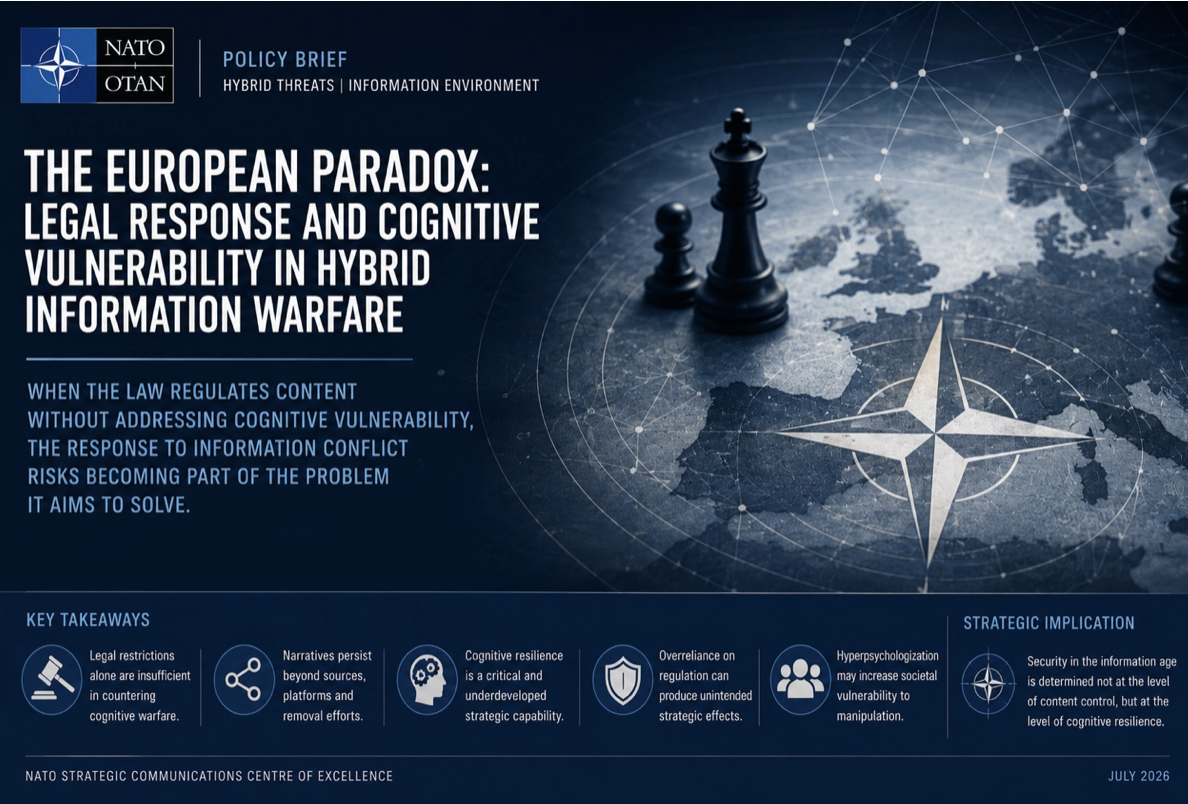

The European Paradox: Legal Response and Cognitive Vulnerability in Hybrid Information Warfare
1. Context
On 2 July 2026, the Court of Justice of the European Union issued its ruling in Case C-67/25 concerning the dissemination of content originating from Russia Today (RT), a media outlet subject to EU sanctions following Russia’s invasion of Ukraine.
The Court confirmed a broad interpretation of EU sanctions law, extending restrictions on dissemination to non-professional actors who republish or redistribute sanctioned media content.
While legally consistent within the EU sanctions framework, the ruling raises broader strategic questions regarding the effectiveness of legal instruments in addressing cognitive warfare in contemporary information environments.
2. Strategic Issue
The core issue is not legal coherence, but strategic effectiveness in a transformed cognitive environment.
Digital information ecosystems are characterized by:
- decoupling of content from original sources
- instantaneous replication and redistribution
- persistence of narratives beyond platforms
- decentralization of information flows
In this context, restricting a source does not necessarily eliminate the narrative. It may instead fragment, displace, or even amplify its symbolic visibility.
3. Cognitive Warfare Dynamics
Cognitive warfare does not primarily operate through content alone, but through:
- interpretive frames
- emotional activation mechanisms
- selective exposure and salience
- trust/distrust construction toward institutions
- information saturation dynamics
Consequently, targeting dissemination vectors without addressing cognitive processing capacities limits strategic effectiveness.
4. Paradoxical Effects of Restrictive Measures
In highly polarized environments, restrictive information measures may generate unintended effects:
- increased attention toward prohibited content
- reinforcement of censorship narratives
- erosion of institutional trust
These are not deterministic outcomes, but recurring risks in contested information environments.
5. Structural Limitation of a Restriction-Centric Approach
A strategy primarily based on:
- bans
- removals
- dissemination sanctions
remains incomplete if it does not address the cognitive dimension of resilience.
The decisive factor in cognitive warfare is not only information availability, but the interpretive capacity of populations.
6. Cognitive Resilience as Strategic Requirement
A more robust approach requires investment in systemic cognitive resilience, including:
- advanced media literacy
- recognition of manipulation techniques
- understanding of cognitive biases
- logical and inferential reasoning skills
- prebunking and pre-exposure strategies
The objective is not to restrict exposure, but to increase interpretive immunity.
7. Structural Hypothesis: Hyperpsychologization
A relevant but underexplored factor is the progressive hyperpsychologization of Western societies.
This refers to the increasing tendency to interpret social, political, and geopolitical phenomena through individual psychological categories (emotions, perceptions, identities, subjective narratives).
While beneficial in certain domains, this shift may have systemic side effects:
- reduced attention to structural and systemic analysis
- increased focus on individual experience over collective dynamics
- lower capacity to identify coordinated influence operations
This may contribute to increased societal susceptibility to cognitive warfare techniques.
8. Strategic Implications
The ruling C-67/25 illustrates a broader structural tension:
- Legal instruments operate on information flows
- Cognitive warfare operates on perception systems
This mismatch suggests that purely regulatory responses risk addressing symptoms rather than underlying vulnerabilities.
9. Conclusion
The Court’s ruling is legally consistent and institutionally coherent. However, its strategic implications highlight a deeper issue: the effectiveness of legal containment strategies in an adaptive cognitive environment.
The central challenge is not simply the regulation of information dissemination, but the development of resilient cognitive structures within societies.
In contemporary hybrid threat environments, security is increasingly determined not at the level of content control, but at the level of cognitive processing.
Key Takeaways
- Legal restrictions on information dissemination alone are insufficient to counter cognitive warfare.
- In digital ecosystems, narratives persist independently from their original sources.
- Cognitive resilience of populations is a critical, underdeveloped dimension of hybrid threat response.
- Overreliance on regulatory containment may produce unintended strategic effects.
- Structural “hyperpsychologization” of Western societies may increase cognitive vulnerability.


