



The EU-China Trade and Investment Consultations: the Structural Limits of Rebalancing and the Question of European Autonom
Introduction: The real problem is not negotiating, but understanding what is negotiable
The new round of Trade and Investment Consultations (TIC) between the European Union and the People’s Republic of China formally begins with an apparently shared objective: stabilizing and improving the balance of trade and investment relations. The first ministerial meeting, between European Commissioner for Trade and Economic Security Maroš Šefčovič and Chinese Minister of Commerce Wang Wentao, took place in Brussels on June 29, 2026. The two sides identified four areas of work: balancing trade and investment, export controls, intellectual property, and reform of the World Trade Organization. (portugal.representation.ec.europa.eu (https://portugal.representation.ec.europa.eu/atualidade-e-eventos/atualidade/declaracao-conjunta-imprensa-do-comissario-sefcovic-e-do-ministro-wang-2026-06-29_pt?utm_source=chatgpt.com))
At first sight, therefore, the problem seems to be the classic one of a trade negotiation: identifying the respective demands, establishing room for compromise, and arriving at reciprocal concessions.
But this reading risks being misleading.
The real issue of the TIC is not, in fact, to establish what concessions the EU can ask of China, nor merely which concessions Beijing might be willing to offer. The decisive question is much deeper: are European and Chinese expectations actually reconcilable, given the structural nature of the trade imbalance and the development model pursued by Beijing?
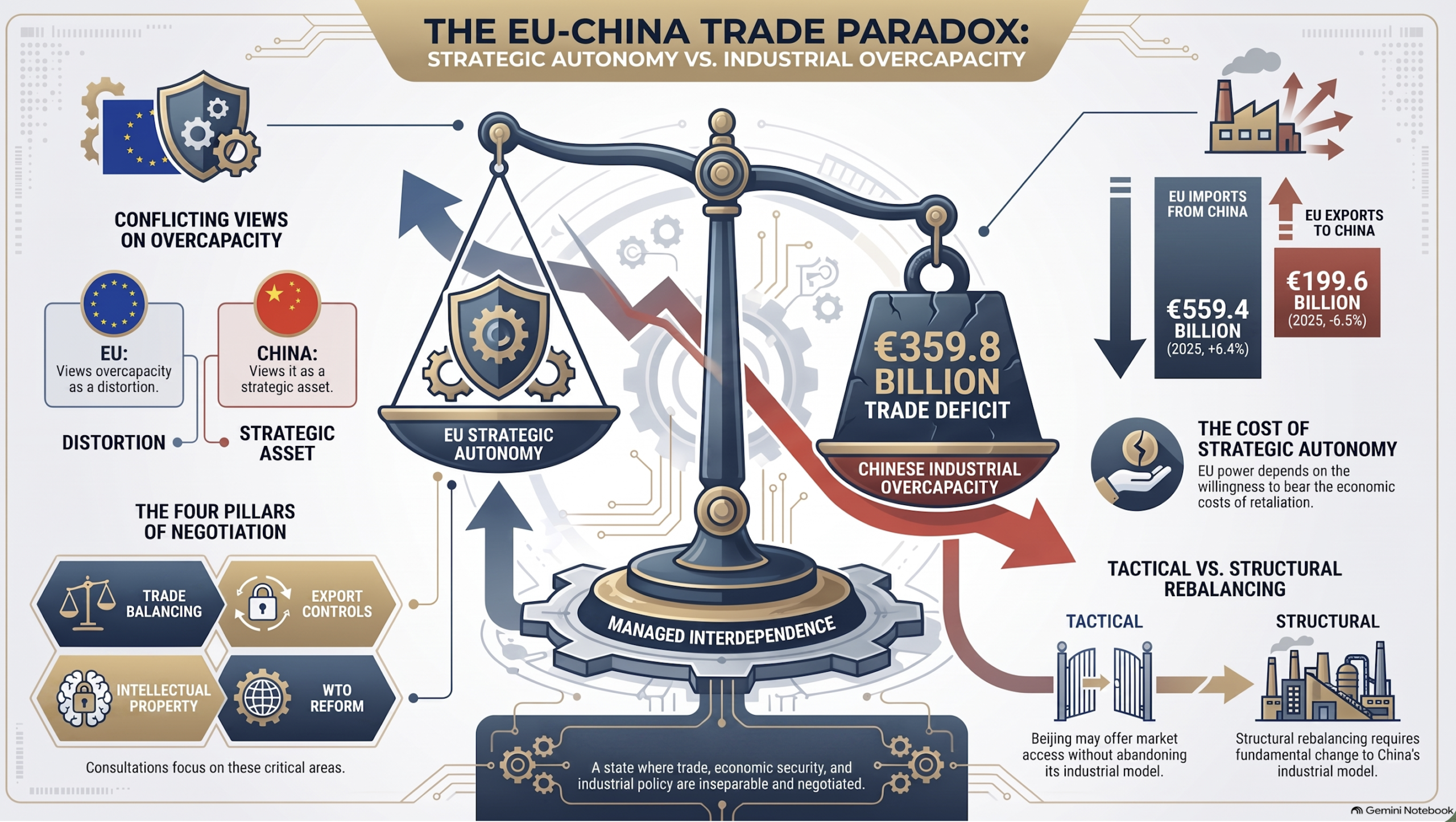
The question becomes even more significant when one considers that the EU’s trade deficit with China is no longer merely a statistical or sectoral problem. In 2025, the EU’s goods trade deficit reached €359.8 billion: the Union exported €199.6 billion worth of goods to China and imported €559.4 billion. Compared with 2024, European exports decreased by 6.5%, while imports increased by 6.4%. (ec.europa.eu (https://ec.europa.eu/eurostat/fr/web/products-eurostat-news/w/ddn-20260410-2?utm_source=chatgpt.com))
This is the figure that transforms the TIC from a simple instrument for managing trade relations into a test of the very possibility of rebalancing the economic relationship between Europe and China.
The problem, therefore, is not only how much Brussels can obtain from Beijing. It is to understand whether what Brussels considers necessary is compatible with what Beijing considers necessary for its own economic security, development, and, more broadly, its position in the strategic competition with the United States.
Trade imbalance as a strategic problem
The European Union has now defined its trade imbalance with China as a structural problem.
Already at the July 2025 EU-China Summit, the European Council had described trade relations as “critically imbalanced,” linking the growing European deficit to systemic distortions in the Chinese market and increasing manufacturing overcapacity. At the same time, the EU called for progress on market-access issues and indicated that, in the absence of negotiated solutions, it would adopt proportionate measures consistent with international law to protect its interests. (consilium.europa.eu (https://www.consilium.europa.eu/en/press/press-releases/2025/07/24/25th-eu-china-summit-eu-press-release/?utm_source=chatgpt.com))
Meanwhile, however, the problem has worsened further.
The 2025 data show that the relationship is not simply fluctuating around a relatively stable equilibrium. The dynamic is moving in the opposite direction: European imports from China are increasing while European exports to China are decreasing. (ec.europa.eu (https://ec.europa.eu/eurostat/fr/web/products-eurostat-news/w/ddn-20260410-2?utm_source=chatgpt.com))
This makes it more difficult to argue that the problem can be resolved through a series of limited trade concessions.
If the deficit were primarily the result of specific tariff barriers, the solution could be relatively straightforward: negotiate tariff reductions, open certain sectors, and facilitate specific investments.
But if the imbalance is also produced by structural differences between the two economies, by China’s industrial policy, by overcapacity, by subsidies, and by the different positions of companies in their respective markets, then the problem is qualitatively different.
It is no longer merely a question of opening a market.
It is a question of modifying, at least partially, the functioning of an economic model.
And this is where the fundamental limit of the negotiation emerges.
The problem of Chinese industrial policy
China is not accidentally pursuing a competitive position that generates large exportable surpluses.
Chinese industrial policy has long been based on a combination of public support, development of productive capacity, technological advancement, the pursuit of self-sufficiency in strategic sectors, and the progressive acquisition of positions in global value chains.
This model is particularly evident in technologically advanced sectors and industries considered strategic for national economic security.
From the European perspective, however, precisely this combination produces a significant part of the distortions that Brussels intends to correct.
The EU complains about growing Chinese industrial overcapacity, unequal competitive conditions, and difficulties accessing the Chinese market. At the same time, Beijing considers the building of industrial and technological capacity an essential component of its resilience and economic security.
This creates a contradiction that is difficult to avoid.
What the EU considers a distortion to be corrected may, from the Chinese perspective, be a strategic instrument to be preserved.
This distinction is fundamental.
Beijing may be willing to correct some of the consequences of its industrial policy without being willing to modify the industrial policy itself.
It may, for example, offer greater access to certain European products, facilitate administrative procedures, improve certain intellectual-property protection mechanisms, or promote selected imports.
But this does not necessarily mean that it is prepared to reduce Chinese production capacity in sectors considered strategic, nor to abandon the goal of securing increasingly important positions in international markets.
The problem of the TIC therefore becomes one of distinguishing between tactical concessions and structural changes.
The first paradox of the TIC
The first paradox can be expressed in very simple terms.
The EU is asking China to contribute to trade rebalancing.
China, however, has an interest in maintaining strong export capacity.
The EU considers Chinese overcapacity one of the causes of the problem.
China, by contrast, considers the expansion of its industrial capacity one of the fundamental instruments for maintaining growth, employment, competitiveness, and technological leadership.
The EU would like greater penetration by its companies into the Chinese market.
China simultaneously wants to develop domestic companies capable of occupying the most advanced segments of value chains.
Is it therefore possible to find a compromise?
Probably yes, but only if a distinction is made between quantitative rebalancing and structural rebalancing.
Quantitative rebalancing could be achieved through increased Chinese imports from Europe, greater opening of certain markets, or a redistribution of specific trade flows.
Structural rebalancing, by contrast, would require deeper changes in the conditions determining the relative competitiveness of the two economies.
And it is precisely the second type of rebalancing that appears much more difficult to achieve.
The four pillars: negotiating the consequences or the causes?
The choice of the four TIC pillars is therefore significant.
The first, trade and investment balancing, is the one directly connected to the deficit problem.
The parties have also agreed to work through lists of market-access problems and a joint mechanism for monitoring trade flows. (slovenia.representation.ec.europa.eu (https://slovenia.representation.ec.europa.eu/novice-dogodki/novice/minister-za-trgovino-ljudske-republike-kitajske-wang-wentao-na-obisku-v-bruslju-2026-06-30_sl?prefLang=lt&utm_source=chatgpt.com))
This is important because it introduces a concrete and verifiable dimension into the negotiation.
But the fundamental question remains: can an increase in European exports to China structurally offset an industrial dynamic that continues to generate enormous Chinese exportable surpluses?
The second pillar, export controls, is even more delicate.
The issue of Chinese restrictions on critical raw materials and rare earths has shown how European dependence on certain elements of Chinese supply chains can be transformed into geopolitical leverage.
The problem, however, is reciprocal.
Beijing is increasingly focused on European controls on sensitive technologies and on Western restrictions on China’s access to certain advanced technologies.
It is therefore unlikely that negotiations on export controls can be separated from the broader issue of economic security.
The third pillar, intellectual property, offers greater possibilities for concrete results because it concerns rules and practices that are relatively identifiable. But here too the question is whether improved enforcement can significantly change the competitive position of European companies.
The fourth pillar, WTO reform, represents the systemic level of the negotiation. It is probably the area in which the two sides share the greatest interest in preserving multilateralism, but for precisely that reason it is also the area least immediately effective in correcting the bilateral deficit.
In other words, the four pillars could make it possible to manage the manifestations of the economic conflict without necessarily resolving its causes.
The American variable
What makes the picture even more complex is the fact that China does not view its relationship with Europe in isolation.
Beijing must assess every European concession also in light of the broader competition with the United States.
This is probably the point most likely to be underestimated if the TIC is analyzed exclusively through the lens of European trade policy.
China does not simply have to decide how much to concede to Europe.
It has to decide how much space to give Europe without weakening its own position in the competition with Washington.
This changes the very function of the EU in Chinese strategy.
If Beijing regards the United States as the principal systemic competitor in technological, financial, military, and geopolitical terms, Europe can simultaneously represent:
- an important market;
- a source of technology and investment;
- a trading partner;
- a potential political interlocutor;
- but also an element of the broader Western system of technological containment and economic security.
From this perspective, Beijing may have an interest in avoiding a trade conflict with Europe, but not necessarily in satisfying all European demands.
Indeed, it may have an incentive to concede enough to prevent Brussels from aligning itself further with Washington, without conceding so much as to undermine its own industrial strategy.
This could be one of the keys to interpreting the TIC.
Europe between trade power and strategic autonomy
At this point the most controversial question emerges: how much negotiating power does the European Union actually possess?
It would, however, be reductive simply to state that the EU lacks autonomy because it depends on the United States.
The EU possesses extraordinary market power and important trade-policy instruments. The Commission is also strengthening its autonomous economic-security toolkit: on June 26, 2026, the European framework for screening foreign investments was formally strengthened, with the aim of identifying and addressing risks to security, critical technologies, and supply-chain resilience. (policy.trade.ec.europa.eu (https://policy.trade.ec.europa.eu/news/eu-strengthens-its-foreign-investment-screening-framework-2026-06-26_en?utm_source=chatgpt.com))
The EU therefore possesses economic power.
The question is whether it possesses the same degree of autonomous strategic power.
Here the answer is much more problematic.
A trade policy can be exercised autonomously at the legal and institutional level. But its geopolitical effectiveness depends on the ability to bear the consequences of the other side’s response.
A European tariff on a Chinese product can be adopted by Brussels.
But if Beijing responds by restricting European access to rare earths, imposing restrictions on certain products, or targeting European companies operating in China, the issue immediately becomes broader.
At that point, energy, technology, supply-chain security, industrial policy, investment, defense, and transatlantic relations all come into play.
It is at this stage that the problem of European autonomy becomes concrete.
The real measure of European power: the willingness to bear the costs
For this reason, the correct question should not be:
“Does the EU have trade instruments?”
The answer is obviously yes.
The question should be:
“How much is the EU willing to pay to use those instruments?”
This is the measure of the credibility of its negotiating leverage.
China may ask itself, in turn:
If Brussels imposes tougher measures, would it be politically capable of maintaining them in the face of the economic consequences?
And again:
Would the member states be willing to bear possible Chinese retaliation?
And finally:
In the event of a prolonged confrontation, would the EU be able to manage it autonomously, or would it need increasingly close coordination with the United States?
These questions are much more important than simply listing the available trade instruments.
Because negotiating power does not coincide with the availability of an instrument; it coincides with the credibility of the threat to use it and to bear its costs.
The paradox of interdependence
And this is where a second paradox emerges.
The EU wants to reduce its dependence on China.
But to do so it must use instruments that could, at least in the short term, increase the costs for its own economy.
China wants to reduce its vulnerability to the West.
But at the same time it needs Western markets to capitalize on the productive capacity that its own industrial model continues to generate.
Both sides therefore want to reduce their vulnerability without giving up the benefits of interdependence.
This makes a genuine economic separation unlikely.
But it makes an outright return to the old model of “business as usual” equally unlikely.
The relationship appears destined to enter a third phase: neither full liberalization nor decoupling.
Rather, a form of managed interdependence, in which trade, economic security, and industrial policy become progressively inseparable.
What can the TIC realistically achieve?
In light of all this, it would probably be a mistake to assess the success of the TIC solely on the basis of a reduction in the trade deficit.
The deficit could remain very large even in the presence of an agreement considered politically positive.
The real criterion should instead be whether the TIC succeeds in producing verifiable mechanisms for rebalancing and managing conflict.
From this perspective, some outcomes are realistic:
- greater access for European products to the Chinese market;
- a selective increase in Chinese imports from Europe;
- greater transparency regarding export controls;
- consultation mechanisms on rare earths and critical raw materials;
- improvements in intellectual-property protection;
- greater predictability for investment;
- mechanisms for monitoring trade flows.
Much more difficult, by contrast, would be obtaining from China a substantial revision of its own industrial-policy model.
And this is precisely where the structural limit of the negotiation lies.
A possible equilibrium: accommodation, not transformation
The most realistic outcome could therefore be mutual accommodation.
China could grant Europe a certain degree of trade rebalancing and some sectoral openings.
Europe could avoid, at least temporarily, a generalized escalation of defensive instruments.
Beijing could thus avoid opening a second major Western trade front precisely while it is concentrating resources on the confrontation with the United States.
Brussels, for its part, could demonstrate that it is capable of obtaining results through negotiation and gain time to strengthen its economic resilience.
From this perspective, the TIC would not be so much the instrument through which Europe and China resolve their imbalance as the mechanism through which they seek to prevent the imbalance from degenerating into a permanent trade conflict.
And that is a substantial difference.
The final question: how negotiable is China and how autonomous is Europe?
The real question emerging from the entire process is therefore twofold.
On the one hand:
How genuinely negotiable is the Chinese economic model?
If industrial policy, technological self-sufficiency, and the expansion of productive capacity are regarded by Beijing as elements of national security, willingness to modify the underlying causes of the trade surplus will necessarily be limited.
On the other hand:
How genuinely autonomous is the EU in using its economic power?
Europe possesses an enormous market, significant regulatory capacity, and trade instruments capable of imposing real costs on China.
But transforming this economic power into strategic autonomy requires the ability to bear the consequences of a prolonged confrontation.
The issue is therefore not whether Europe can adopt trade measures against China.
It can.
The issue is whether it can do so without the need to manage the consequences of those measures inevitably bringing it back into a broader strategy defined in coordination with Washington.
This distinction — between trade autonomy and strategic autonomy — makes it possible to understand the true meaning of the TIC.
Conclusion
The new Trade and Investment Consultations therefore represent a political and economic experiment of much greater scope than their name suggests.
The EU comes to the negotiating table with a real and growing problem: a trade deficit of almost €360 billion, increasingly strong penetration of Chinese products into the European market, difficulties in accessing the Chinese market, and growing concern over industrial overcapacity. (ec.europa.eu (https://ec.europa.eu/eurostat/fr/web/products-eurostat-news/w/ddn-20260410-2?utm_source=chatgpt.com))
China comes to the table with equally concrete needs: sustaining growth, maintaining employment and competitiveness, leveraging productive capacity, accelerating technological self-sufficiency, and preserving its position in the competition with the United States.
This is precisely where the two agendas come into tension.
Europe wants to rebalance.
China wants to preserve its competitive capacity.
Europe interprets overcapacity as a distortion.
China considers it, at least in part, a strategic asset.
Europe wants to reduce dependencies.
China wants to reduce its own vulnerability to the West.
And both have an interest in preventing the economic conflict from degenerating into open strategic confrontation.
This suggests that the most likely outcome of the TIC is not a radical transformation of the relationship, but a form of negotiated management of interdependence.
The success of the process should therefore not be measured by its ability to rapidly eliminate the trade deficit.
It should be measured by the ability of the two sides to determine what level of imbalance, dependence, and competition they are both willing to tolerate without turning the economic relationship into an open strategic conflict.
And this is precisely where the question of European autonomy lies.
The EU possesses instruments powerful enough to impose costs on China. What remains to be demonstrated is whether it also possesses the political cohesion, economic resilience, and strategic capacity necessary to sustain their use.
The real test of the TIC, therefore, will not be Beijing alone.
It will also be Brussels.
Because the negotiation with China will force Europe to answer a question that it has so far been able to leave relatively undefined:
How much economic power is it actually willing to transform into political power and, above all, what price is it willing to pay to do so?


