


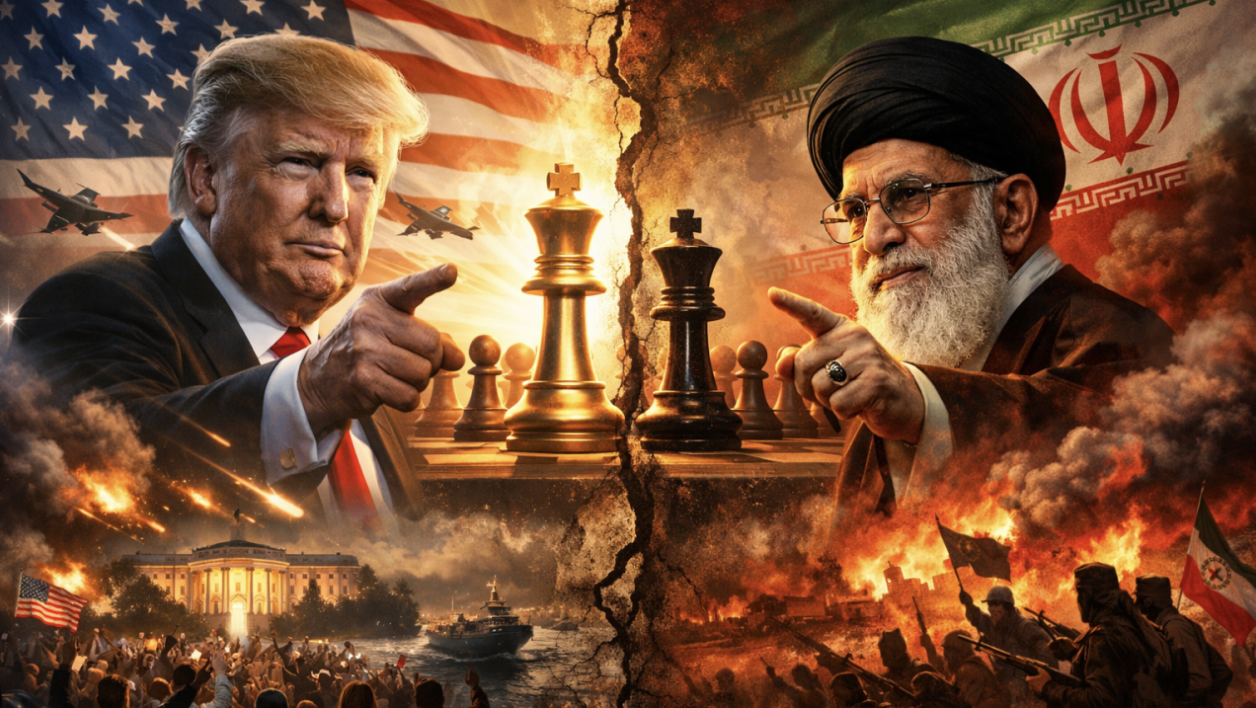

Trump–Tehran: The narrative war has begun.
Since the beginning of hostilities, many have first looked at maps, bases, missiles, straits, oil terminals. But, as the US strikes weakened Iran and the war entered its third week, the true center of gravity shifted. The theater of operations is no longer just military. It is now narrative, psychological, and political. And, at this precise moment, Donald Trump seems to dominate this new battlefield.
Why? Because he succeeded in imposing a simple, brutal, legible image: Iran has taken the brunt of the shock, Iran is seeking an exit, and it is Washington who sets the time, the pace, and the conditions for a possible halt. “Reuters” reports that regional mediations, notably from Oman and Egypt, have been repelled by Donald Trump, while Tehran maintains that no ceasefire is possible without stopping strikes and compensation. It changes everything. In a war, the one who refuses to negotiate at the moment when the other gives a glimpse of an exit door appears, at least temporarily, as the master of the game.
This is where the crucial point lies. We may not be at the end yet, but we are clearly at a turning point. Because the question is no longer just: who hits the hardest? The real question has become: who imposes the reading of war? But Trump is trying to impose the idea that the war will not stop on a compromise, but on a hierarchy restored to the American advantage. His repeated threats on Kharg, a vital hub for Iranian oil exports, and his call to other powers to secure the Strait of Hormuz reflect a clear will: transform military superiority into political supremacy.
The mullahs—or more exactly the Iranian power apparatus as it operates today, in a context of fragmentation and hardening — are trying to create a counter-narrative. They want to appear not as defeated, but as an aggressive, resilient regime still capable of regional nuisance. Iran remains open to discreet diplomacy, while claiming to be betrayed by the US and Israeli strikes. Tehran is looking for an outcome?, but one that does not resemble a public capitulation.
In other words, Iran is not just looking for a deal; it is looking for a deal that allows it to save face. And that’s precisely where Donald Trump is trying to politically trap him. Because by refusing any de-escalation too early, he wants to plant in people’s minds a formidable idea: it is no longer Tehran that negotiates, it is Tehran that begs. For a regime that has based its legitimacy on resistance, it is an existential danger. the real front is there: not only the destruction of infrastructure, but the destruction of Iranian strategic prestige.
The domination of the narrative does not yet mean strategic victory. This is even the classic trap. The American President dominates the narrative today because he seems to hold the initiative. But the longer a war lasts, the more the narrative can turn against the one who started it. “Reuters” points out that the effective closure of Ormuz disrupts an axis through which about one fifth of global oil passes, that the barrel has jumped by more than 40% during the month, and that importing states are starting to activate their reserves from the International Energy Agency in Japan. A narrative victory can be quick; an energy crisis, on the other hand, quickly erodes political positions.
If Donald Trump quickly converts his narrative advantage into an exit framework—that is, into political conditions imposed on Iran — he could say that he has not only struck, but reconfigured the regional balance of power. But if he delays, if he lets the conflict take hold, if it causes a lasting crisis of supplies, then the narrative can change sides: he will no longer be the man who restored order, but the one who opened a war that he does not know how to close. for the moment, not all the allies asked to secure Ormuz have responded present, which shows that the American narrative has not yet become a solid political coalition.
Yes, D Trump currently dominates the narrative, because he gives the image of the cold force in the face of an Iran that seeks a solution without being able to publicly assume it. But the crucial point at which we have arrived is not yet that of the regulation; it is that of setting the terms of the regulation. And in the history of wars, it is often at this precise moment that everything changes: either power transforms its superiority into a political order, or it lets itself be trapped by the duration, wear and the consequences it believed it could control.
The war between the United States and Iran is no longer just a matter of missiles and drones. It now opposes two wills to tell the world who still commands. For the moment, the symbolic advantage is with the American President . But in a narrative war as in a real war, the most dangerous moment is often that when one believes having already won.


