



Is Iran seeking to politically exhaust the United States?
This may be the central question in the current crisis between Washington and Tehran. Is Iran seeking to politically exhaust America, complicate its leadership, weaken its alliances, and make every American decision more costly?
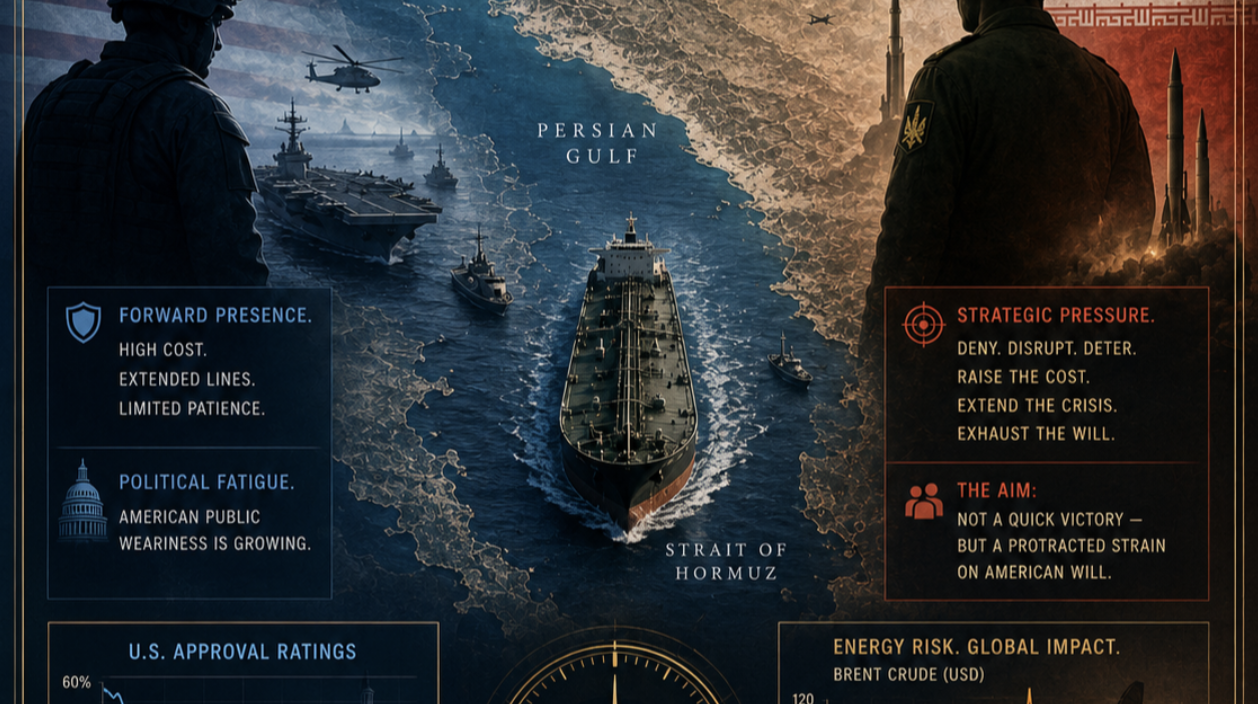
The answer is quite clear: Iran is not seeking a classic military victory. It knows that is impossible. The power gap is too great. But that does not mean Iran lacks a strategy. On the contrary. Its strategy consists precisely in avoiding the terrain where America is strongest, and instead drawing it onto ground where it is more vulnerable: political time, regional cost, public opinion, markets, alliances, and strategic fatigue.
This is the classic logic of weaker powers facing dominant ones. They do not aim to win militarily. They seek to prevent the other from turning military superiority into political victory. That is the crucial difference between defeating an army and exhausting a strategy.
Iran understands this very well. It knows the United States can strike hard. But it also knows America does not want a long, costly, uncertain, and unpopular war. The real American vulnerability is not its army. It is its ability to maintain a coherent strategy over time. Tehran is not trying to destroy American power. It seeks to make it difficult to use.
Iranian attacks on installations linked to American forces in the Gulf fit this logic. They send a political message: any escalation against Iran will have a regional price. The Gulf countries hosting American bases thus become pressure points. This is Tehran’s way of broadening the cost of the crisis and pushing Washington’s allies to call for de-escalation. The latest attacks on American installations in several Gulf states, and Iran’s threats around the Strait of Hormuz, are part of this strategy of regional pressure.
The second analytical window concerns the Strait of Hormuz. It is not just a maritime passage. It is a geopolitical lever, a weapon of nuisance, an instrument of negotiation. It only takes creating uncertainty, slowing traffic, multiplying incidents. This uncertainty is enough to drive up energy prices, worry investors, and remind major powers that Iran can touch a sensitive nerve of the world economy.
Here we see the difference between military power and the power of nuisance. In an interdependent world, creating disorder can become a form of power. The Strait of Hormuz is essential because it has long carried about a fifth of global oil and gas flows; this explains why every incident there immediately produces a global strategic effect.
The third window is American political psychology. This is Iran’s calculation: push Washington to strike, but not too hard; provoke an American response, but maintain space for negotiation; create a crisis, but avoid annihilation. In other words, Tehran is testing the American threshold. How many strikes? How many losses? How much pressure on allies? How many oil price hikes?
This strategy is risky, but not irrational. It rests on an intuition: in democracies, war is not only a military matter. It is also a matter of public opinion, political coalition, election cycles, and narrative. If Iran manages to turn every American strike into a diplomatic problem, every Iranian response into an energy concern, every attack in the Gulf into pressure on allies, then it can hope to shift the crisis from the military to the political field.
This is probably what Tehran seeks: to trap the United States in a contradiction. If Washington strikes too hard, there is a risk of regional conflagration. If it negotiates, it may seem to be giving in. If it refuses to negotiate, it may be accused of prolonging the crisis for the world economy. In any case, Iran tries to turn American superiority into strategic embarrassment.
But especially on the iranian domestic front, the regime must show it does not give in. Military response thus serves to hold the home front. In this logic, Iran’s response is not only a military action; it is a staging of sovereignty.
But every strategy has its limits. A very deadly Iranian strike, a miscalculation around Hormuz, or a more massive than expected American response could tip the crisis. History shows that military crises often slip out of the control of those who think they master them.
Thus, the real question becomes: can Iran politically exhaust the United States without provoking a war it cannot win?
Weaker powers always hope to outlast the great powers—not by winning the war, but by preventing the other from winning the peace.


