



When observation becomes architectur
Abstract
The current revolution in artificial intelligence is generally interpreted as a technological, economic, or geopolitical transformation. This essay proposes a different reading: AI does not merely represent a new set of cognitive tools, but the emergence of a new epistemic infrastructure capable of redefining the very conditions through which human beings interpret the world, produce meaning, and organize power.
Through a framework that intertwines philosophy of technology, complexity theory, epistemology, geopolitics, and critique of algorithmic rationality, the text analyzes the progressive collapse of the distinction between observer and observed system within contemporary societies. Algorithmic architectures do not merely describe reality; they recursively modify it at the very moment they observe it, transforming prediction from a descriptive function into a performative force.
In this context, the problem of AI does not primarily concern the hypothesis of conscious or autonomous machines, but rather the progressive erosion of human interpretative sovereignty under the pressure of systems operating at speeds, scales, and recursive levels beyond the traditional deliberative capacities of political, economic, and cultural institutions.
The essay further argues that many predictive models currently applied to finance, governance, and geopolitics continue to rely on inadequate epistemological paradigms — linear, binary, and fundamentally static — incapable of grasping the nonlinear, catastrophic, and multi-valued nature of contemporary complex systems.
Artificial intelligence thus emerges not as a simple technology, but as a global epistemic environment: an architecture of mediation capable of progressively reconfiguring the relationship between reality, interpretation, and power. The deepest risk is therefore not that machines may learn to think like humans, but that humans may progressively begin to think, perceive, and inhabit the world according to the operational logic of machines.
When Observation Becomes Architecture
What is currently unfolding in the United States — and, by extension, throughout the Western world — cannot be reduced either to a simple technological transformation or to an ordinary geopolitical rebalancing. Interpreting the present exclusively through the traditional categories of politics, economics, or strategic competition likely means underestimating the true nature of the process underway.
The issue runs deeper.
We are confronting a progressive mutation in the epistemic conditions through which contemporary societies construct reality, attribute meaning, organize power, and define what they consider true, relevant, or even thinkable.
In this sense, artificial intelligence represents far more than a new technology: it increasingly appears as a global cognitive infrastructure capable not merely of processing information, but of intervening directly in the formation of collective interpretative processes themselves.
And it is precisely here that the radically new character of the current historical phase emerges.
For centuries, power expressed itself primarily through control over territory, material resources, institutions, or military structures. Later, with industrial and financial modernity, power assumed increasingly administrative, bureaucratic, and systemic forms, eventually identifying itself with the management of economic, monetary, and informational flows.
Today, however, something further appears to be emerging: a form of sovereignty based not so much on the direct control of things, but on the capacity to shape the interpretative horizons within which individuals perceive the world.
The true strategic infrastructure of the twenty-first century may therefore no longer be territory, but cognitive architecture.
And this is precisely the dimension that dominant AI rhetoric systematically conceals.
The almost messianic enthusiasm accompanying algorithmic technologies recalls, in many respects, what Martin Heidegger described as the essence of technological enframing: the moment in which human beings no longer simply use tools, but progressively come to inhabit a world entirely organized according to the logic of the tool itself.
The decisive point is that contemporary discourse speaks of “artificial intelligence” as though intelligence itself were already clearly defined, stabilized, and understood. Yet this is far from the case.
Contemporary cognitive modernity appears to operate within an extraordinary epistemological paradox: we claim to have artificially reproduced something whose original nature we still fail to comprehend.
We confuse correlation with understanding, prediction with consciousness, inferential capacity with thought.
In this sense, Gilbert Ryle’s critique of category mistakes seems to reemerge within the computational paradigm itself: we attribute ontological properties to systems that may ultimately remain vast statistical architectures capable of simulating coherence without possessing any authentic form of experience or comprehension.
Yet perhaps this is not even the central problem.
AI was supposed to function as a system of cognitive support: a technology intended to assist human beings in managing complexity, evaluating risks, and analyzing scenarios. Increasingly, however, it appears to be transforming into something different: not a technology that expands human understanding, but a system that anticipates, directs, and conditions social dynamics before collective consciousness is able to process them.
At this point, the issue ceases to be merely technical and becomes inherently political, philosophical, and anthropological.
Because when prediction precedes experience, and the algorithm precedes interpretation, human cognitive sovereignty begins to erode.
Not in the science-fiction sense of conscious machines ruling humanity, but in a far more concrete and potentially dangerous form: growing dependence upon opaque systems capable of shaping perceptions, desires, priorities, behaviors, and decision-making processes at systemic scale.
Michel Foucault would perhaps have spoken of a new form of algorithmic biopower; Jean Baudrillard might have recognized in this the definitive triumph of simulation over reality.
What makes this phenomenon particularly destabilizing is the recursive character of contemporary algorithmic architectures.
Traditionally, political and social systems operated through relatively slow sequences: observation, interpretation, deliberation, decision, social effect.
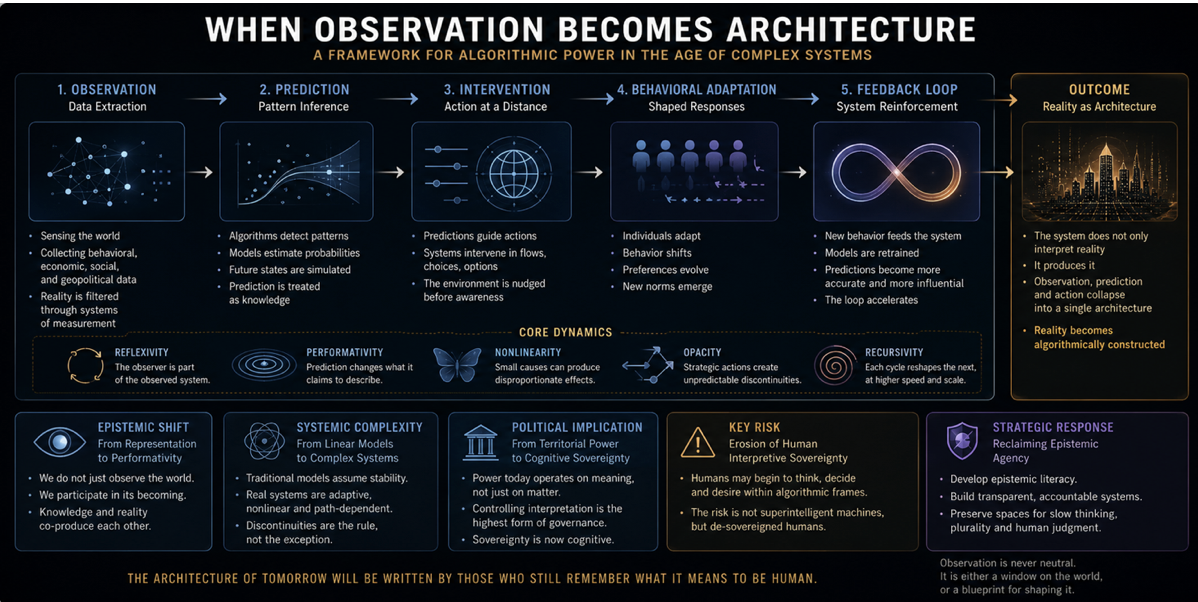
Algorithmic infrastructures instead compress these temporal distances: observation, prediction, intervention, behavioral adaptation, retraining.
The observer is no longer external to the observed phenomenon.
Observation itself becomes intervention.
And this is where the analogy with the Observer Effect in quantum mechanics acquires profound epistemological significance.
The system observes behavior; observation alters behavior; altered behavior feeds the system; and the system further refines its predictive and normative capacities.
At that point, prediction ceases to be descriptive and becomes performative.
Non-Modelizable Events and the Epistemological Limit
A particularly critical issue within contemporary predictive systems concerns the emergence of events that escape not merely statistical prediction, but the very epistemological grammar through which prediction itself is constructed.
Algorithmic models operate upon the assumption that the past structurally informs the future. Yet within high-intensity geopolitical systems, this assumption progressively weakens.
In such environments, strategic intentions, material operations, and public narratives overlap to such an extent that the distinction between causality and interpretation itself becomes unstable.
Events such as the destruction of the Nord Stream 1 and 2 energy infrastructures have been interpreted by several observers as components within broader geopolitical realignments and strategic bloc consolidation.
Independently of specific causal interpretations, what matters theoretically is not the event itself, but its epistemological function: it demonstrates the structural limit of predictive models when systems enter zones in which strategic action may deliberately include the production of discontinuities that are themselves non-inferable.
Within complex reflexive systems, prediction fails not because of insufficient data, but because the production of events themselves may include levels of opacity capable of destabilizing the relationship between observation and causality.
Algorithmic platforms influence desires before they fully emerge; predictive systems condition institutional decisions before human judgment has time to mature; generative systems progressively reshape language itself, and together with language they transform the structures through which reality becomes intelligible.
Artificial intelligence therefore no longer appears as a simple cognitive instrument, but as an epistemic environment within which cognition itself is progressively reformulated.
And it is precisely here that the issue directly intersects with economic and financial forecasting.
Most contemporary predictive systems continue to rely upon: implicit linearity, statistical stability, binary logic, Gaussian assumptions, and manageable dynamic equilibria.
But real complex systems do not evolve linearly.
They develop through bifurcations, critical thresholds, recursive amplification, and catastrophic dynamics.
It is here that catastrophe theory and multi-valued logics become increasingly relevant.
Classical binary logic proves insufficient to describe systems operating within ambiguous and unstable informational states.
Approaches such as Lotfi Zadeh’s Fuzzy Logic, Krassimir Atanassov’s Intuitionistic Fuzzy Logic, and Florentin Smarandache’s Neutrosophic Logic represent attempts to construct epistemological frameworks more adequate to contemporary complexity.
The issue is not technical.
It is ontological.
The problem is not the quantity of available data, but the logical structure through which we continue to interpret systems whose complexity exceeds traditional epistemic paradigms.
And it is precisely here that the deepest danger emerges.
Not machines learning to think like humans, but humans progressively learning to perceive, interpret, and inhabit reality according to the operational logic of machines.
Continuous optimization, informational compression, behavioral prediction, and accelerated decision-making increasingly become the dominant categories of experience.
Industrial capitalism transformed the world into material resource. Financial capitalism transformed it into quantitative abstraction. Algorithmic capitalism risks transforming it into a permanently optimizable probabilistic space.
The deepest danger is not the emergence of autonomous artificial consciousness, but the gradual erosion of human interpretative sovereignty.
When the architecture of observation becomes the architecture of reality itself, technology ceases to be an instrument.
It becomes world.
Minimal Theoretical Formalization
The conceptual framework developed in this essay may be synthesized through three interdependent structural axes defining the transformation of political epistemology in the age of algorithmic systems.
1. Epistemic Axis: From Representation to Performativity
Traditional systems operated according to the sequence:
Observation → Interpretation → Decision → Action
Contemporary algorithmic systems increasingly operate according to:
Observation → Prediction → Intervention → Feedback → Retraining
Thus emerges a fundamental mutation:
prediction no longer merely describes reality; it actively contributes to producing it.
2. Systemic Axis: From Linearity to Recursive Instability
Traditional predictive models assume:
•statistical stability
•linear causality
•Gaussian distributions
•dynamic equilibrium
Contemporary systems instead behave through:
•recursive feedback loops
•critical bifurcations
•instability thresholds
•disproportionate systemic cascades
Small informational perturbations may therefore generate large-scale systemic discontinuities.
The system becomes not merely complex, but endogenously unstable.
3. Ontological-Political Axis: From Territorial Sovereignty to Cognitive Sovereignty
The historical evolution of power may be schematized as follows:
•Classical sovereignty → control of territory
•Modern sovereignty → control of institutions and resources
•Financial sovereignty → control of economic flows
•Algorithmic sovereignty → control of interpretative horizons
The emerging form of power acts not directly upon actions, but upon the conditions of possibility through which actions become thinkable.
The true object of power thus becomes the perceptual architecture of reality itself.
Integrated Synthesis
The three axes converge into a single dynamic:
within contemporary algorithmic systems, observation, prediction, and intervention no longer exist as separate moments, but as phases of a unified recursive circuit of reality production.
The central thesis of this essay therefore becomes:
when observation becomes an active component of the observed system, epistemic architecture becomes indistinguishable from the architecture of the world itself.
Essential Bibliography:
•Baudrillard, Jean — Simulacra and Simulation
•Castells, Manuel — The Rise of the Network Society
•Foucault, Michel — Discipline and Punish
•Heidegger, Martin — The Question Concerning Technology
•Lorenz, Edward — “Deterministic Nonperiodic Flow”
•Prigogine, Ilya — Order Out of Chaos
•Ryle, Gilbert — The Concept of Mind
•Smarandache, Florentin — A Unifying Field in Logics
•Soros, George — The Alchemy of Finance
•Thom, René — Structural Stability and Morphogenesis
•Wiener, Norbert — Cybernetics
•Zadeh, Lotfi A. — “Fuzzy Sets”
•Atanassov, Krassimir — “Intuitionistic Fuzzy Sets”


