



Iran–United States: The clock war has begun
On television panels, two narratives now clash almost mechanically. On one side are those who support Donald Trump and are desperately searching for the still-invisible American strategy—one that would explain the hesitations, delays, and unfulfilled threats, and which would soon prove that Washington had foreseen everything. On the other side are those who have already decided that the United States has lost. For them, the mere fact that negotiations are progressing between Iran and Oman, without direct American presence at the table, is already proof of a strategic retreat by Washington.
But these two interpretations may share a common flaw: they are already seeking a winner when the balance of power has not yet played out all its effects. The real question may lie elsewhere: who is currently the most eager to reach an agreement? And above all, who can wait the longest?
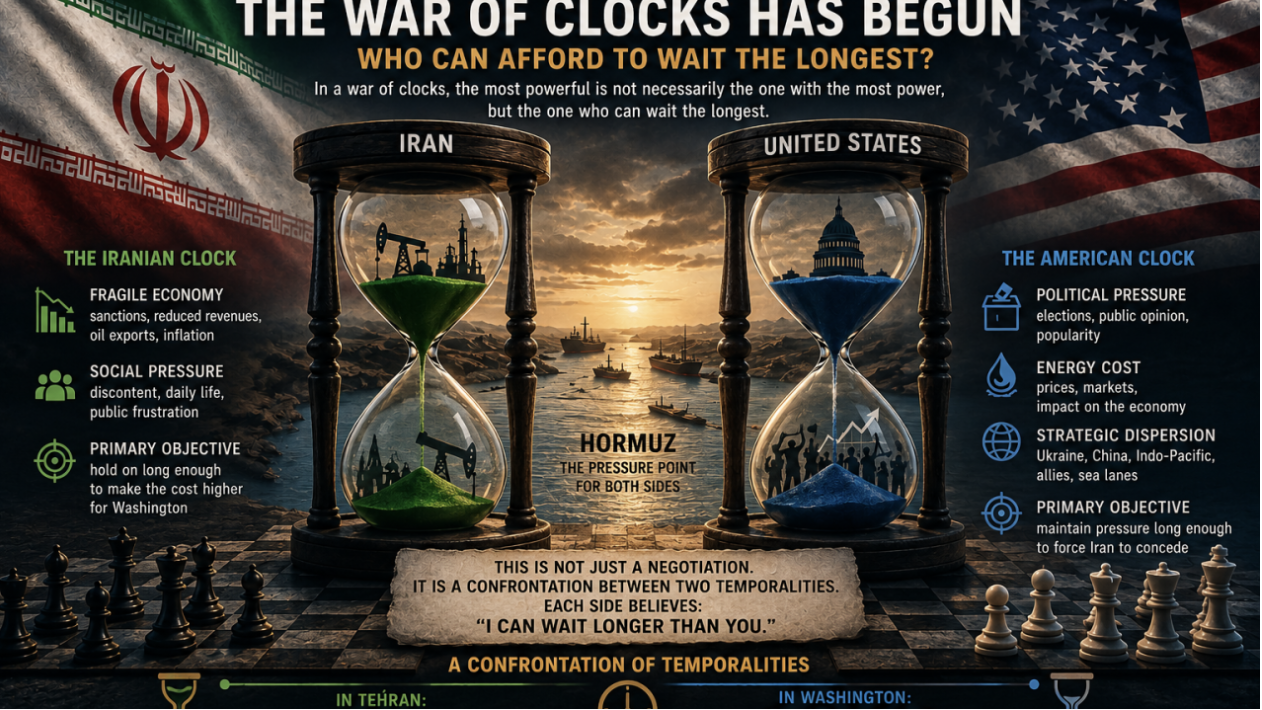
Here, we can evoke the “war of the clocks.” A war of the clocks arises when two adversaries perceive time differently. The strategy is no longer to defeat the opponent immediately, but to prolong the crisis long enough for the cost of time to outweigh our own. In other words: in a conflict related to the clock, the winner is not necessarily the one with the greatest means, but rather the one who can display patience for the longest period.
At first glance, it seems that Iran is the most pressed actor. Its economy is under strain. The real impacts of sanctions, export barriers, energy tensions, reduced income, and pressure on the population are all present. The longer this situation lasts, the more the Iranian regime faces economic pressure that could eventually turn into a social, then political, crisis. Thus, Washington enjoys a clear advantage: it hopes that the pressure will eventually force Tehran to accept a deal.
But Iran also possesses a major lever: Hormuz. By maintaining uncertainty about navigation through the strait, manipulating energy flows, and managing the level of regional tension, Tehran can force others to bear part of the cost of its own resistance. This is precisely where the balance of power becomes more complex.
Militarily, economically, and financially, the United States far surpasses Iran in terms of power. However, strength does not necessarily mean that time is on their side. Washington also has a clock. It is a political question. A persistent energy crisis, prohibitive costs, unstable markets, growing pressure on allies, waning public opinion, and the American electoral calendar are all likely to gradually diminish the White House’s room for maneuver.
To this is added another constraint: strategic dispersion. The United States is not only dealing with Iran. It must also monitor Russia, Ukraine, the Indo-Pacific, China, Taiwan, its European alliances, and several strategic maritime routes. American time is therefore also a matter of resources, priorities, and focus.
We then arrive at a central paradox: Iran may be the most pressed economically, while the United States may be the most pressed politically and strategically. That is why it is still too early to speak of victory or defeat.
Tehran seems to be betting on a simple idea: to hold out long enough for the political, economic, and energy cost of the crisis to become too heavy for Washington. The United States is making exactly the opposite bet: to maintain pressure long enough for the economic and social cost to become too heavy for Tehran.
We are therefore no longer only in a diplomatic negotiation. We are in a confrontation between two timelines. In Tehran, the clock of the economy is ticking. In Washington, the clock of politics, energy, and strategic dispersion is also ticking.
The right question is therefore no longer just: “Who is the most powerful?” It becomes: “Who will reach their breaking point first?” This is the entire logic of the war of the clocks. And in this type of confrontation, one must never confuse superiority in power with superiority in timing.
The history of power struggles shows that a weaker actor can achieve more than expected if they manage to use time as a negotiating tool. This is surely what Washington and Tehran are trying to do today. Each is trying to prove to the other: “I can wait longer than you.”
And as long as no one has proven otherwise, it is too soon to say who has truly won.


