


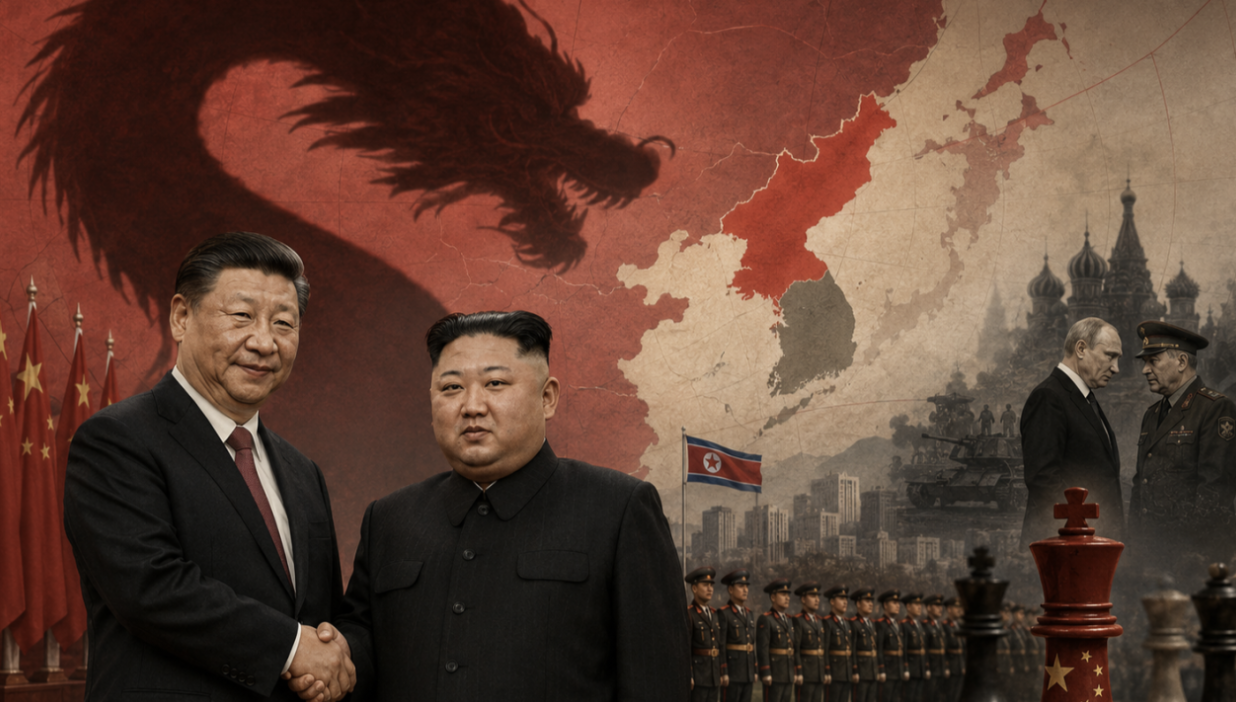

Xi in Pyongyang: China Reminds North Korea Who Holds the Key
Diplomatic trips are not limited to simple official visits. They are messages. And sometimes even reminders of order.
The announced visit of Xi Jinping to North Korea on June 8-9, 2026, should be read as follows. Officially, it is about strengthening ties between Beijing and Pyongyang. The friendship between two close regimes, two neighbors, two countries that share the same distrust of the United States. Something has altered since the conflict in Ukraine: Vladimir Putin and Kim Jong-un have become closer. Russia needs partners because it is sanctioned, isolated, and involved in an extended conflict. For its part, North Korea wants energy, money, recognition, possibly technology, and most importantly, a less wary guardian than China. Everyone finds something to be interested in between Pyongyang and Moscow.
But for Beijing, this rapprochement is not insignificant. China does not want North Korea to become too Russian. It doesn’t want to lose its role as the main sponsor. It does not want another actor, even Russia, to occupy too much space in an area that it considers essential for its security.
This is where the true meaning of Xi Jinping’s trip lies. He will not only salute Kim Jong-un. He will remind a hierarchy. He will say, without saying it, that Moscow can be a useful partner, but that Beijing remains the indispensable power.
For China, North Korea is both an asset and a problem. An asset, because it functions as a strategic protection against South Korea, Japan and US bases. A problem, because a North Korean regime that is too autonomous, too nuclearized, too unpredictable, could cause a crisis that Beijing would no longer control.
So China wants a stable, dependent North Korea, but not entirely uncontrollable. She does not want the regime to collapse, as this would create chaos on her border. However, because every North Korean provocation forces Seoul, Tokyo, and Washington to increase their military cooperation, it also opposes a too-hostile North Korea. And Beijing is in a terrible situation.
“Kim Jong-un performs his own scores.” He recognizes that his nation is economically vulnerable; however, he also recognizes that its capacity to inflict damage constitutes its foreign strength. North Korea does not need to be rich to count. It needs to be dangerous, unpredictable, useful to some, worrisome to others.
This is the whole strategy of Pyongyang: to turn its isolation into political rent. The more Kim is courted by Moscow, the more he can negotiate with Beijing. The more he worries Washington, the more inevitable he becomes. He does not want to be just the satellite of China. He wants to be an actor that several powers must take into account.
And that is precisely what worries Xi Jinping
China sees that North Korea is seeking to expand its policy space. She sees that Russia offers her a new strategic window. She can see that the Beijing-Moscow-Pyongyang triangle is not as simple as it seems. From the outside, one might think of a united authoritarian bloc against the West. But in reality, within this bloc, each first defends its own interests.
That’s why this trip is important. It should not be taken as a mere diplomatic photo. It should be read as a strategic reordering.
Xi wishes to remind Kim Jong-un that China remains the dominant power on the Korean Peninsula. He also wants to send a message to Washington, Seoul, and Tokyo: no serious discussion of North Korea, North Korean nuclear power, or the balance in Northeast Asia can take place without Beijing.
This is the complexity of Chinese power. Beijing wants to appear as the big arbiter, the one who speaks to Trump, Putin, Kim, and the countries of the global south. But the further China goes, the more it must deal with contradictions within its own camp.
Therefore, the primary lesson is clear: coalitions are never automatic, especially between totalitarian governments. Power struggles, rivalry, and mistrust are all involved. Despite having a shared enemy, China, Russia, and North Korea do not necessarily have the same interests.
And perhaps that is the real message of this visit: North Korea can talk to Moscow, provoke Washington, worry Seoul and Tokyo. But in the end, Beijing wants to remain the essential passage. it is the friendship between two close regimes, two neighbors, two countries that share the same mistrust of the United States. But behind the official image, there is something else: China wants to take back control of North Korea.
This is where the true meaning of Xi Jinping’s trip lies. He will not only salute Kim Jong-un. He will remind a hierarchy. He will say, without saying it, that Moscow can be a useful partner, but that Beijing remains the indispensable power.
Kim Jong-un, however, is playing his own game. He knows that his country is economically weak. But he also knows that its capacity to create trouble gives it diplomatic value. North Korea does not need to be rich in order to matter. It needs to be dangerous, unpredictable, useful to some, and worrying to others.
This is Pyongyang’s strategy: turning isolation into political rent
The lesson is simple: even between authoritarian regimes, alliances are never automatic. There is mistrust. There is competition. There are power struggles. China, Russia, and North Korea may share a common adversary, but that does not mean they share the same interests.
Xi is going to Pyongyang to remind everyone of one essential fact: in this region, Russia may enter the game, but China intends to remain the power holding the key.


