


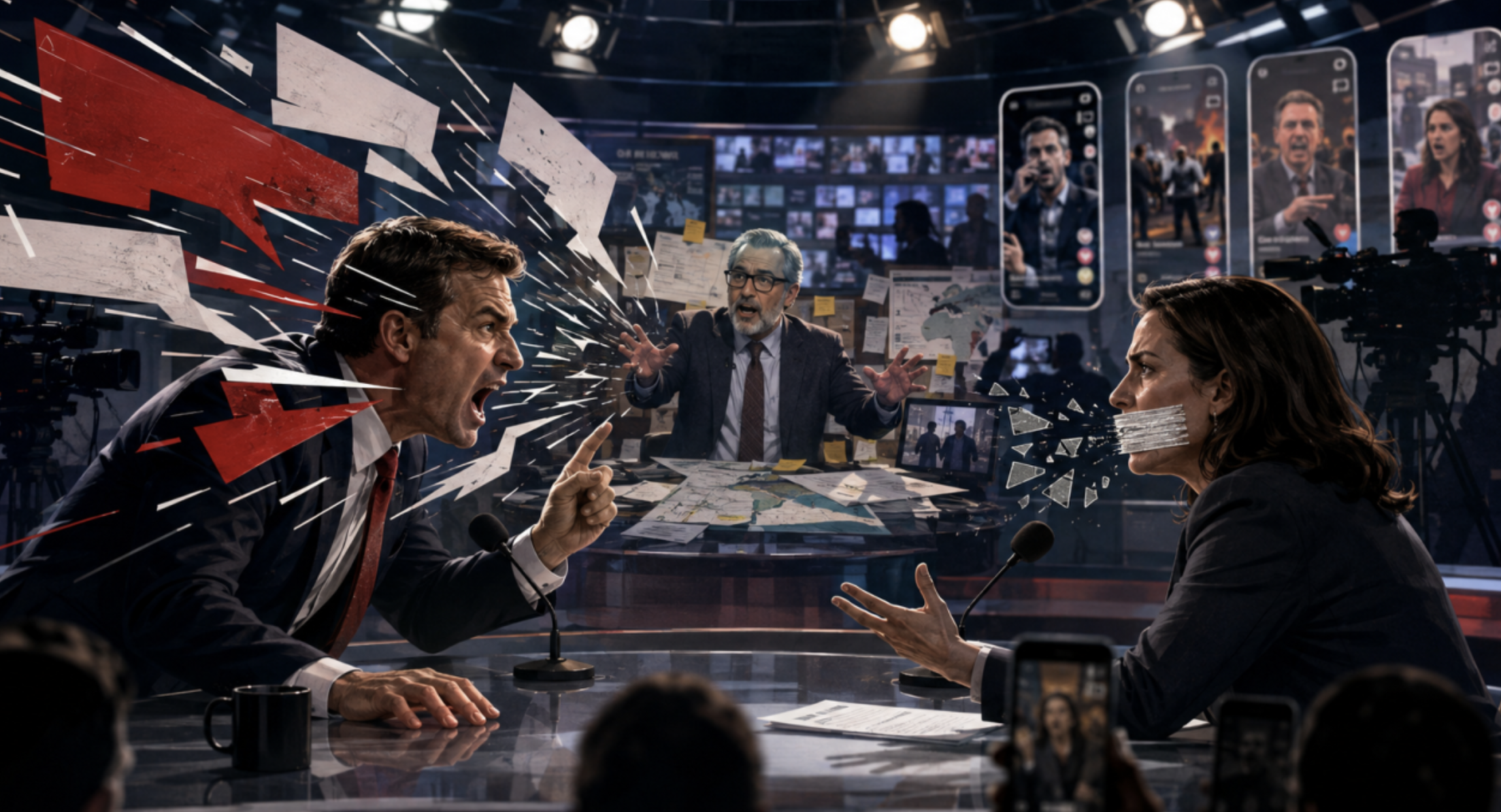

Usa – Israel – Iran: The invisible table
Let us, however, not misunderstand the meaning of this piece. It is neither a criticism of the United States nor an indictment of its foreign policy. Unfortunately, it is only an observation: that of a sequence that has become confused, repetitive, and sometimes almost unreal, even as its human and strategic consequences are extremely serious. Noting this drift does not mean choosing a side. It simply means observing that words, threats, and negotiations now seem to contradict each other to the point of making any rational reading of the crisis increasingly difficult.
Today’s episode. Donald Trump promises a massive attack on Iran. The general staffs prepare, Gulf capitals hold their breath, and news channels launch their countdowns.
Then, at the last moment, the attack is canceled.
The American president announces that Iran wants to negotiate. Tehran responds that it is not negotiating. Washington claims that discussions have begun. Iran clarifies that no meeting is scheduled. A few hours later, the military threat is back on the table.
The next day, same setting, same actors, same dramatic music. Only the statement changes slightly.
We are no longer quite facing an international crisis. We are facing a serial in which no one truly knows the script, not even those who seem to be writing it.
The White House presents: “The strike that might not happen.”
In the past, geopolitics at least had the appearance of gravity. A threat was preceded by a diplomatic note, followed by an ultimatum, then accompanied by military maneuvers that analysts tried to decipher.
Today, a social media post can move markets, put several armies on alert, and be contradicted before dinner.
The American president claims that Iran asked to come to the table. Iran responds that there is neither table, nor chair, nor meeting. One can almost imagine diplomats looking for the meeting room while both governments explain that it exists and does not exist simultaneously.
Thus, diplomacy has entered the era of quantum mechanics: the negotiation is open and closed at the same time, the attack is decided but suspended, peace is imminent but war continues.
Everyone watches the situation, waiting for someone to open the box.
Deterrence turned into a trailer
The classical theory of coercion was based on a relatively simple idea: to be effective, a threat had to be credible. It had to show real capability, political will, and some consistency between words and deeds.
In the new strategic theater, the threat looks more like a movie trailer. It must be spectacular, immediate, and sufficiently worrying to occupy media space.
Sometimes, it doesn’t even matter whether the movie is ever released. The main thing is that everyone is talking about it.
The problem is that a threat repeated and then withdrawn gradually loses its value. The first cancellation can be presented as an act of responsibility. The second as a chance given to diplomacy. By the tenth, it starts to look like an alarm bell that no one really takes seriously anymore.
But the paradox is dangerous: unpredictability can also maintain fear. Because Donald Trump has already changed his mind quickly, no one can completely rule out that the next threat will be carried out.
Credibility then no longer depends on consistency, but on uncertainty.
It is no longer deterrence by control. It is deterrence by vertigo.
Tehran may mainly be negotiating the narrative
Iran is not a mere spectator in this comedy. Its systematic denial also has its own logic.
By denying the talks announced by Washington, Tehran protects its image of resistance, avoids appearing as the petitioner, and turns every American statement into a possible public humiliation.
The scene is effective: Donald Trump announces that Iran begged to negotiate; Iran replies that Donald Trump is talking to himself.
Washington wants to show that pressure works. Tehran wants to show that America is inventing a diplomatic victory because it cannot achieve a political one.
Meanwhile, intermediaries are probably talking, messages are circulating, conditions are being tested, and everyone gains a few hours. Iranian authorities have acknowledged exchanges with Oman about maritime routes, while denying the existence of direct negotiations with Washington.
The denial does not necessarily prevent diplomacy. It becomes an instrument of it.
One can negotiate in secret while publicly denying that one is negotiating. This has even become one of the specialties of this crisis.
Everyone is rational, so nothing is
This may be the heart of the problem.
Each actor maintains its own rationality. Donald Trump wants to exert maximum pressure without locking himself into a long war. Iran wants to buy time, preserve its regime, and show that it is not giving in. Gulf countries want to avoid an escalation that would threaten their infrastructures. Israel wants to prevent diplomacy from giving Tehran a new reprieve.
The markets, for their part, just want to know if the Strait of Hormuz will be open tomorrow morning. They have even responded positively to de-escalation announcements, despite lingering uncertainty about the very existence of negotiations.
Taken separately, each behavior can be explained.
Put together, they produce an almost absurd sequence.
Everyone acts rationally in the very short term, but the whole becomes profoundly irrational. Announcements contradict each other, red lines move, ultimatums expire and then are reborn, and strategic truth sometimes lasts no longer than a news cycle.
The tragedy behind the parody
It would, however, be dangerous to laugh too long.
Behind this spectacle lies the Iranian people, subjected to war, destruction, sanctions, repression, and uncertainty. There are soldiers who may die based on a decision made and then canceled. There are sailors crossing the Strait of Hormuz without knowing whether the next hour will be commercial or military.
There are families who hear talk of peace in the morning and “decapitation” in the evening.
The parody is therefore not about suffering. It is about the contrast between the gravity of the consequences and the apparent lightness of political communication.
The more theatrical the language becomes, the more dangerous reality becomes.
When each threat must be more spectacular than the last, there comes a time when one of the actors must act simply not to lose face.
Geopolitics has not disappeared: it has changed grammar
Geopolitics has not become totally irrational. It has become more personalized, more instantaneous, more narrative, and more dependent on staging.
Institutions still matter. Power relations too. But they are now covered by a permanent layer of communication, denials, contradictory messages, and presidential drama.
We have moved from a geopolitics where we tried to predict decisions to a geopolitics where we try to interpret mood swings.
From a diplomacy of secret channels to a diplomacy of public statements.
From a strategy built over time to a strategy rewritten with each episode.
The most worrying thing is not that no one is rational. It is that everyone has their own rationality, their own schedule, and their own truth.
In this system, war can start by mistake, peace can be announced without existing, and a negotiation can be denied by those conducting it.
Next episode: Washington may promise a strike at midnight, Tehran will announce it has received no message, a mediator will claim that a deal is close, and the markets will celebrate peace for a few hours.
Unless, of course, the episode is canceled at 11:57 p.m.


