


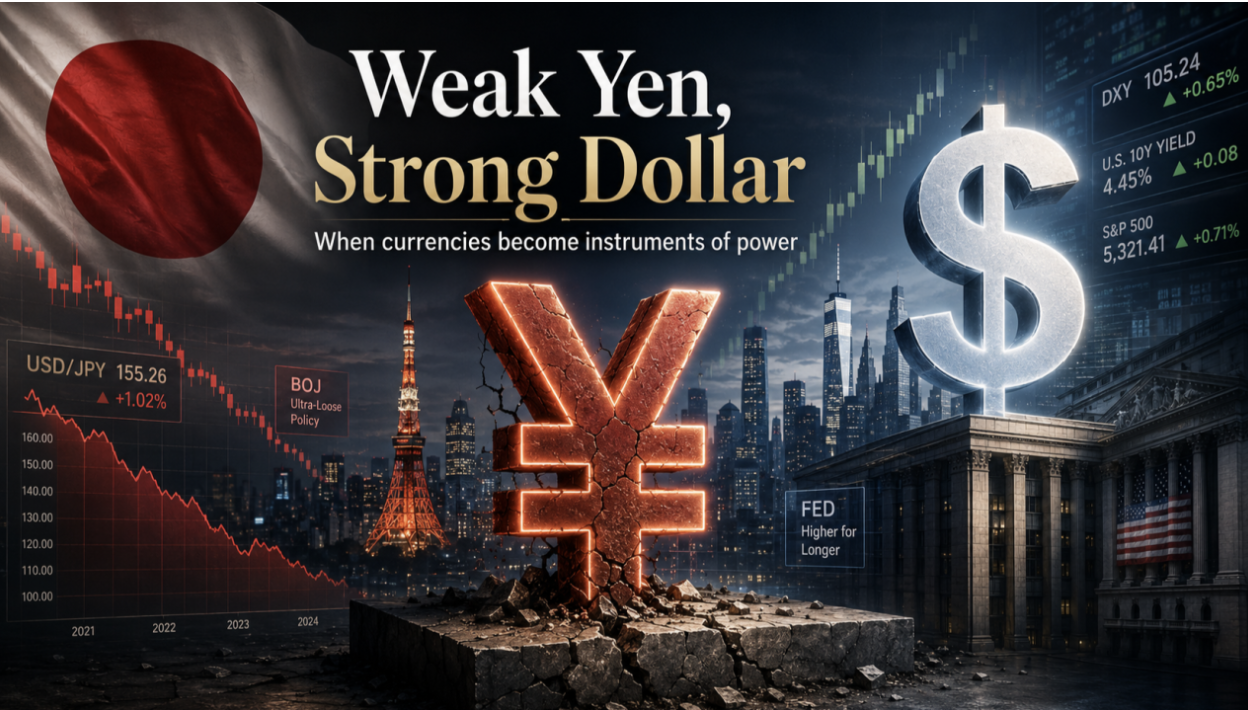

When the Yen Becomes a Geopolitical Signal
It is often believed that currencies belong to the world of markets, central banks and trading rooms. This is true, of course. But in an unstable world, a currency is never just a financial instrument; it also becomes a political signal. It says something about trust, dependence, the real power of a country.
That is why the weakness of the Japanese yen deserves a geopolitical reading. The subject may seem technical: the yen is down against the dollar, markets are speculating about a possible intervention by Tokyo, and the Bank of Japan is torn between maintaining monetary stability and supporting the economy. But behind this financial mechanism lies a deeper question: can Japan still fully control the conditions of its economic power?
The weak yen has a classic explanation first. US rates remain more attractive than Japanese rates. Investors therefore prefer to invest their money in dollars rather than in yen. This is simple logic: when a currency yields less, it becomes less attractive. The problem for Tokyo is that this financial logic produces political consequences.
Because a weak yen is not just a line on a graph. It changes everyday life. It increases imports. It weighs on energy, on food, on products purchased abroad. For a country that relies heavily on energy imports, weak currencies can quickly become social pressures. Japan can attract more tourists; its exporters may benefit, but households pay part of the bill.
This is where the currency becomes a subject of sovereignty. Tokyo can intervene in the foreign exchange market to support the yen. But an intervention does not always change the underlying trend. It can surprise speculators, slow down the decline, and send a message. But while the US-Japan rate spread remains wide, the market often reverts to its core logic. In other words, Japan can correct an excessive move, but it cannot ignore America’s financial gravity.
This is the Japanese paradox. Japan is a great economic, technological, and industrial power. It is a central US ally in Asia, playing a major role against China and in the Indo-Pacific security architecture. Yet its currency is reminiscent of dependence: dependence on the dollar, on US Federal Reserve decisions, and on global capital movements.
This does not mean that Japan is weak. It means that modern power has become more complicated. You can have a strong military, advanced industry, and active diplomacy, yet still be vulnerable because of your currency. Power is no longer measured only in carriers, missiles, or alliances. It is also measured in the ability to protect its purchasing power, stabilize its currency, reassure markets, and finance its debt without losing control of the economic narrative.
The weak yen also shows another reality: in today’s world, currencies have become instruments of power relations. The dollar remains the central currency of the international system. When the US keeps rates high, that choice is not just about the US economy. It attracts capital, weakens other currencies, puts pressure on allies like Japan, and complicates foreign central banks’ choices. American monetary policy thus becomes an indirect form of global power.
For Tokyo, the problem is therefore twofold. If it raises rates too quickly, it risks undermining an already-cautious economy with very high public debt and often limited growth. If it does not raise them enough, the yen may continue to weaken, with social and political effects. The Japanese government finds itself caught between two imperatives: supporting its domestic economy and defending the credibility of its currency.
There is also a message for Asia. Compared with China, Japan seeks to present itself as a pillar of stability. But a currency under pressure can give the image of a country constrained by markets. Beijing is observing this, and so is Washington. Japan’s partners also. In a region where power can be read as much in semiconductors, ports, supply chains, and currencies as in military fleets, the yen is becoming a strategic indicator.
The big lesson is therefore simple: geopolitics is no longer separate from finance. A weak currency can become a business advantage, but also a sign of vulnerability. An intervention can be a technical act, but also a political message. A central bank may seem to be talking about inflation, but in reality it is talking about sovereignty.
The yen is not just a weakened currency. It is the mirror of a world in which even US allies must face the consequences of American power. Japan remains a great power. But its currency is a reminder that, in the current international order, no one is completely in control of their autonomy.
Even currencies have become silent battlefields.


