



Iran After the Mullahs: When the Revolution Devours Its Cleric
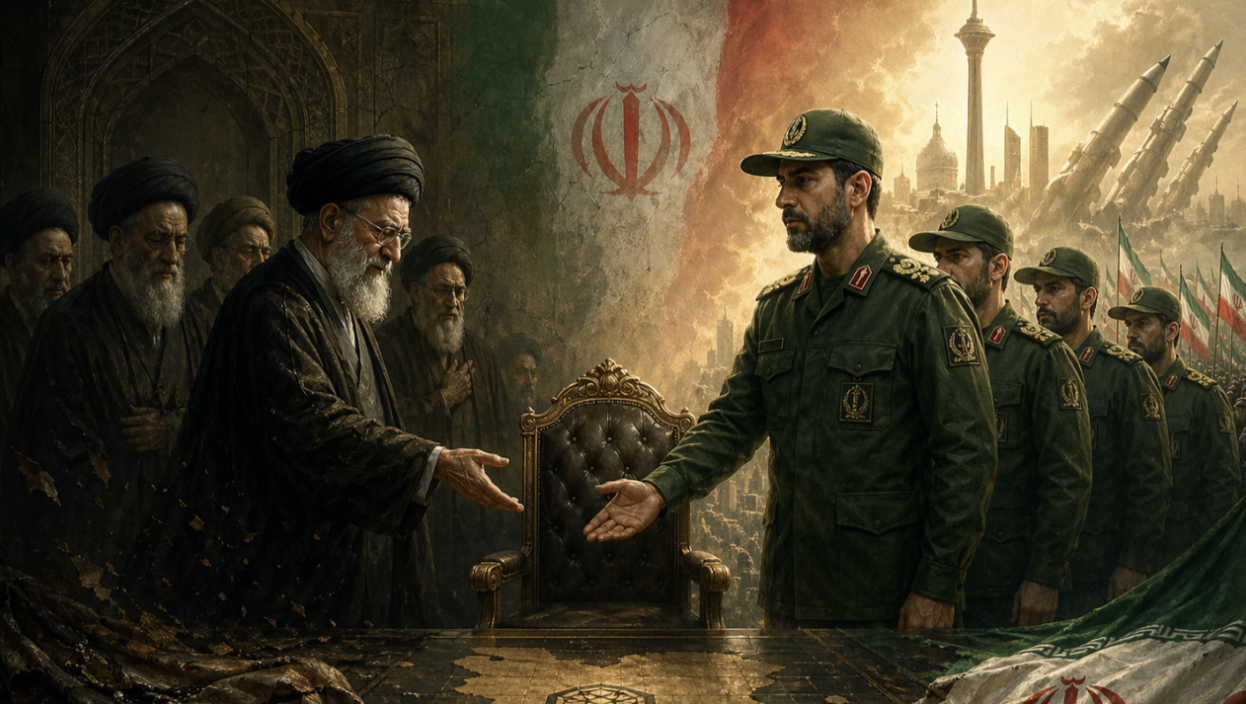
What the US-Israel war may have ended is not the Islamic Republic as a state. It is the theocracy that has structured it since 1979. In its place emerges another order: harder, colder, and also more readable. No longer a regime dominated by the clerics, but a revolutionary militocracy where the Guardians of the Revolution become the real center of power.
We need to be precise. When Washington talks about a change of regime, he often imagines a democratic transition, a street in revolt, a liberal system ready to succeed the old one.This reading focuses more on “strategic desire” than analysis. What is happening in Tehran seems more prosaic: the regime does not disappear, it mutates. The religious summit is weakening, the security apparatus absorbs the rest.
For decades, the Islamic Republic was based on three fragile balances: the authority of the Supreme Leader, the revolutionary legitimacy inherited from 1979, and the tense coexistence between civilian institutions and the military.These three pillars are weakening. If the succession of Ali Khamenei were to be confirmed in a framework largely overseen by the Islamic Revolutionary Guard Corps, then theological legitimacy would no longer be a mere backdrop. The real arbiter would be elsewhere.
The formula sums up the shift: Iran is no longer a state with a powerful militia; it becomes a powerful militia with a state.
This transformation was not born yesterday. Since the 1990s, the IRGC has gradually extended its grip on the economy, media, regional networks, and security structures. The war would then have only accelerated a process already underway: eliminate the remaining checks and balances and reveal the real hierarchy of the system.
Civil institutions continue to exist, but their scope for action is reduced. They administer. The security forces decide. The diplomat speaks; the military settles. This discrepancy is crucial for understanding any future negotiations with Tehran.
There is another Western misunderstanding: to believe that hostility toward the US is merely a tactical option that could be bartered for sanctions or economic guarantees. For the Guardians, resistance is not just a strategy; it is their historical raison d’être. They were created to protect the revolution from inside and outside. To abandon this stance altogether would be tantamount to dissolving oneself politically.
This does not rule out pragmatism or calculation. A military apparatus can negotiate while maintaining pressure. It can speak of peace and prepare for deterrence. Many observers read this as a contradiction; on the contrary, it is often a method.
So the real question for the years to come is not whether “the regime falls” or “the regime holds.” This binary grid is no longer enough. The question is this: will a Guardian-dominated power be more dangerous or predictable?
Paradoxically, both at the same time. More dangerous, because more militarized. More predictable, as it is less beset by rivalries between competing clerics, pragmatists, and ideologues. The military has its brutalities, but also an institutional logic: to preserve the tool of power.
Perhaps this is the central paradox of the postwar era. By wanting to destroy a system, its adversaries may have contributed to the emergence of a more coherent interlocutor than the one they were fighting. Tougher, of course. But more rational in its calculations.
In geopolitics, the rationality of the adversary often changes more than its nature.


